
UNESCO World Heritage Sites in Georgia: Complete Guide
- November 25, 2026
Georgia is home to ancient churches, medieval mountain villages, archaeological landscapes and remarkable natural ecosystems. Some of these places are internationally recognized for their outstanding cultural or natural significance.
But how many UNESCO World Heritage Sites are there in Georgia, and which ones can you visit?
Georgia has four UNESCO World Heritage Sites: the Historical Monuments of Mtskheta, Gelati Monastery, Upper Svaneti, and the Colchic Rainforests and Wetlands. Three are cultural heritage properties, while one is a natural heritage property.
Together, they offer a fascinating journey through Georgia’s medieval history, religious architecture, traditional mountain communities and ancient forests.
This guide explains what makes each UNESCO-listed site special, where it is located, how to visit and what travelers should know before planning a trip.
We’ll also clarify which famous Georgian landmarks are on UNESCO’s Tentative List rather than its official World Heritage List.
Last reviewed: November 24, 2026. UNESCO designation details reflect the official World Heritage List at the time of review. Visitor access, conservation work and transportation arrangements may change before your trip.
How Many UNESCO World Heritage Sites Are in Georgia?
As of November 2026, Georgia has four properties inscribed on the UNESCO World Heritage List.
|
UNESCO World Heritage Site |
Type |
Inscription year |
Location |
|
Historical Monuments of Mtskheta |
Cultural |
1994 |
Mtskheta, near Tbilisi |
|
Gelati Monastery |
Cultural |
1994 |
Near Kutaisi, Imereti |
|
Upper Svaneti |
Cultural |
1996 |
Northwestern Georgia |
|
Colchic Rainforests and Wetlands |
Natural |
2021 |
Western Georgia’s Black Sea region |
These are four World Heritage properties, not simply four individual buildings.
For example, the Historical Monuments of Mtskheta include several religious monuments, while the Colchic Rainforests and Wetlands consist of seven separate protected component areas.
The official UNESCO country profile provides the complete and current list.
If you’re planning a broader cultural journey, our Best Places to Visit in Georgia guide introduces 30 destinations, including some of the country’s most important historical landmarks.
Historical Monuments of Mtskheta — Georgia’s Ancient Spiritual Center
UNESCO inscription: 1994
Heritage type: Cultural
Location: Mtskheta, Mtskheta-Mtianeti
Best for: Medieval churches, history, architecture and religious heritage
Suggested visit: Half day to full day
Best time: Year-round
Mtskheta is one of Georgia’s oldest and most historically significant towns.
Located near the meeting point of the Mtkvari and Aragvi rivers, it was an important center of the ancient Kingdom of Iberia and played a central role in the development of Christianity in Georgia.
Its medieval churches are among the most remarkable examples of Georgian ecclesiastical architecture.
UNESCO recognizes the Historical Monuments of Mtskheta for their architectural importance and testimony to Georgia’s historical and cultural development.
The World Heritage property comprises three principal monuments.
Svetitskhoveli Cathedral
Svetitskhoveli Cathedral is one of the most significant religious buildings in Georgia.
The existing cathedral largely dates from the 11th century, although the site has a much longer Christian history.
Its monumental stone architecture, carved details and religious traditions make it an important destination for visitors interested in Georgia’s medieval heritage.
The cathedral remains an active place of worship.
Visitors should follow dress requirements, respect religious services and check whether photography is permitted.
Don’t miss: The cathedral’s exterior stonework and the historic streets surrounding the church complex.
Jvari Monastery
Jvari Monastery stands on a hill above Mtskheta, overlooking the confluence of the Aragvi and Mtkvari rivers.
The surviving church is an important example of early medieval Georgian architecture, generally dated to the late 6th and early 7th centuries.
Its location creates one of the most recognizable panoramic views in Georgia.
Jvari is particularly appealing to travelers interested in architecture, history and landscape photography.
Don’t miss: The panoramic viewpoint overlooking Mtskheta and the meeting of the two rivers.
Samtavro Monastery
Samtavro is another important historical and religious complex in Mtskheta.
It is associated with the early history of Christianity in Georgia and the traditions surrounding King Mirian III and Queen Nana.
The complex contains significant religious architecture and remains a functioning monastery.
Compared with Svetitskhoveli and Jvari, Samtavro may receive less attention from visitors planning quick sightseeing trips, but it is an essential part of the UNESCO-listed property.
Don’t miss: The monastery church and its historical religious setting.
How to Visit Mtskheta
Mtskheta is one of the easiest UNESCO destinations to visit from Tbilisi.
The town is located approximately 20 kilometers northwest of the capital.
A half-day excursion allows time to visit the major monuments, although a full day provides a more relaxed experience.
Jvari Monastery is located outside the town center on an elevated site, so a taxi, driver or guided excursion is convenient.
Travel tip: Visit Jvari first for the panoramic view, then continue to Svetitskhoveli Cathedral and Samtavro Monastery.
Mtskheta is an excellent choice for first-time travelers who want to experience Georgia’s religious and architectural heritage without a long journey.
Official UNESCO listing: Historical Monuments of Mtskheta.
Gelati Monastery — A Masterpiece of Medieval Georgia
UNESCO inscription: 1994
Heritage type: Cultural
Location: Near Kutaisi, Imereti
Best for: Medieval architecture, mosaics, frescoes and Georgian history
Suggested visit: One to two hours
Best time: Year-round, subject to conservation-related access restrictions
Gelati Monastery is one of the most important monuments of Georgia’s medieval Golden Age.
Located in the hills near Kutaisi, it was founded in 1106 by King David IV, widely known as David the Builder.
The monastery developed into a major religious, educational and cultural center.
Its historical importance extends beyond its religious function. Gelati was associated with scholarship, intellectual life and the cultural achievements of medieval Georgia.
UNESCO recognizes Gelati for its exceptional architectural and artistic significance.
Why Is Gelati Monastery Important?
Gelati reflects the political strength and cultural flourishing of medieval Georgia during the reigns of King David IV and Queen Tamar.
The complex is particularly notable for its architectural composition and surviving medieval decoration.
Its church interiors include important mosaics and frescoes, although visitor access to particular areas can be affected by conservation measures.
The monastery also holds a special place in Georgian national history because of its association with King David IV.
The Gelati Academy
Gelati is historically associated with an academy that contributed to medieval Georgian intellectual and educational life.
Scholars worked in philosophy, theology and other disciplines, helping establish Gelati as an important center of learning.
This combination of religious, educational and artistic functions is central to understanding the monastery’s heritage.
Is Bagrati Cathedral Also a UNESCO World Heritage Site?
This is an important distinction.
Gelati Monastery and Bagrati Cathedral were originally inscribed together in 1994 under the name Bagrati Cathedral and Gelati Monastery.
However, UNESCO approved a major boundary modification in 2017 that excluded Bagrati Cathedral from the World Heritage property.
The inscription is now officially named Gelati Monastery.
Bagrati Cathedral remains an important historical attraction in Kutaisi, but it should not be presented as a currently inscribed UNESCO World Heritage Site.
How to Visit Gelati Monastery
Gelati is located outside central Kutaisi and can usually be visited as part of a half-day excursion.
Many travelers combine it with sightseeing in Kutaisi and other nearby attractions.
However, conservation and restoration work has been an important issue at Gelati.
Visitors should check current arrangements before traveling, as access to specific buildings, interiors or artworks may be restricted.
Travel tip: Treat any access to interior artwork as conditional. The monastery’s heritage value does not mean every area will be open to tourists.
For more ideas about exploring western Georgia, our Georgia Itinerary: 3, 5, 7, 10 & 14 Days guide includes routes through Kutaisi and nearby destinations.
Official UNESCO listing: Gelati Monastery.
Upper Svaneti — Medieval Towers in the Caucasus Mountains
UNESCO inscription: 1996
Heritage type: Cultural
Location: Upper Svaneti, northwestern Georgia
Best for: Medieval villages, mountain landscapes, Svan culture and hiking
Suggested visit: Three to five days for the wider region
Best time: Summer and early autumn for most outdoor activities
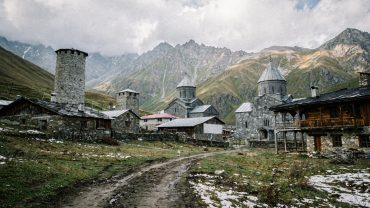
Upper Svaneti is one of Georgia’s most extraordinary cultural landscapes.
Situated in the Greater Caucasus Mountains, the region is known for dramatic peaks, traditional stone houses and medieval defensive towers.
Its relative geographical isolation helped preserve distinctive settlement patterns, architecture and cultural traditions.
Unlike Mtskheta and Gelati, Upper Svaneti is not a single monastery or building.
It is a cultural landscape where the relationship between mountain communities and their environment is central to the UNESCO designation.
What Makes Upper Svaneti a UNESCO Site?
The region’s traditional tower-houses reflect both everyday domestic life and the historical need for defense.
UNESCO particularly highlights the medieval-type villages and defensive architecture of Upper Svaneti.
The traditional buildings demonstrate how communities adapted to challenging mountain conditions while preserving a distinctive cultural identity.
The officially inscribed property is associated with the Ushguli area, including the village of Chazhashi.
Not every village or attraction in the broader Svaneti region lies within the exact UNESCO World Heritage boundaries.
This distinction is important when describing the site accurately.
Ushguli — A Remarkable Mountain Settlement
Ushguli is a group of high-altitude villages surrounded by the dramatic landscapes of the Greater Caucasus.
Its stone towers and traditional architecture create one of the most recognizable views in the country.
The nearby mountains include the imposing Mount Shkhara, Georgia’s highest peak.
Walking through the villages offers insight into historical mountain settlement patterns and surviving Svan traditions.
Chazhashi — The Architectural Heart of the UNESCO Property
Chazhashi is particularly important to the World Heritage designation.
UNESCO describes its exceptional concentration of historic tower-houses and traditional structures.
These buildings were historically used for both living and defensive purposes.
Visitors should treat the village as a living cultural landscape rather than an open-air attraction without restrictions.
Some buildings may be private, residential, fragile or inaccessible.
Mestia — The Main Base for Exploring Svaneti
Mestia is the principal tourism center for Upper Svaneti.
It offers guesthouses, hotels, restaurants, cultural attractions and transportation connections.
Although Mestia is an important part of a Svaneti journey, travelers should not confuse the entire town with the precise boundaries of the UNESCO-inscribed property.
Mestia is especially useful as a base for visiting Ushguli and exploring the wider mountain region.
How to Visit Upper Svaneti
Most travelers approach Svaneti through western Georgia, commonly via Zugdidi or Kutaisi.
The journey to Mestia involves mountain roads and should be planned with realistic travel time.
From Mestia, visitors can continue toward Ushguli using suitable local transportation when road conditions permit.
A longer trip allows time to explore cultural landmarks, experience local hospitality and enjoy the mountain scenery without rushing.
Travel tip: Plan at least three days for Svaneti if you’re arriving from another region, and consider additional time for hiking or possible weather disruptions.
The road to Ushguli can be affected by seasonal snow, heavy rain and other mountain hazards.
For a detailed comparison with Kazbegi, Tusheti and Khevsureti, read our Caucasus Mountain Regions in Georgia guide.
Official UNESCO listing: Upper Svaneti.
Colchic Rainforests and Wetlands — Georgia’s Natural UNESCO Heritage
UNESCO inscription: 2021
Heritage type: Natural
Location: Adjara, Guria and Samegrelo-Zemo Svaneti
Best for: Forests, wetlands, biodiversity and ecotourism
Suggested visit: One to several days, depending on the protected areas
Best time: Generally late spring to early autumn for outdoor exploration
The Colchic Rainforests and Wetlands represent a completely different side of Georgia’s World Heritage.
This is the country’s only natural property on the UNESCO World Heritage List.
Inscribed in 2021, it recognizes the exceptional ecological significance of ancient temperate rainforests and wetland ecosystems along the eastern Black Sea region.
These landscapes contain important habitats for rare, endemic and relict species.
UNESCO recognizes the property for its ecological and biological processes and outstanding biodiversity.
What Are the Colchic Rainforests?
The Colchic rainforests are ancient, highly humid temperate forests.
Their plant communities developed under relatively stable climatic conditions and preserve species associated with much older geological periods.
The region’s ecological diversity is influenced by the Black Sea climate and the surrounding mountains.
Visitors can experience dense vegetation, rivers, forest trails and distinctive subtropical-looking landscapes.
Unlike tropical rainforests, these ecosystems belong to a temperate climatic zone.
What Makes the Colchic Wetlands Special?
The wetlands include peatlands and unusual mire ecosystems that have exceptional scientific and conservation importance.
They provide habitats for a variety of plant and animal species, including important populations of migratory birds.
The Colchic region is also recognized for its distinctive ecological processes and rare wetland environments.
Which Protected Areas Are Included?
The UNESCO property comprises seven component parts situated within four protected-area systems:
Mtirala National Park: Known for humid mountain forests, dense vegetation and designated visitor trails near the Black Sea coast.
Kintrishi Protected Areas: Important for forest biodiversity and distinctive ecosystems in Adjara.
Kobuleti Protected Areas: Known for valuable peatland and wetland habitats.
Kolkheti National Park: Protects significant wetland, lowland forest and aquatic ecosystems in western Georgia.
The inscription does not mean that every part of these four protected areas is included within the exact UNESCO boundary.
Mtirala National Park
Mtirala is one of the more accessible destinations for experiencing Colchic rainforest landscapes.
Located within reach of Batumi and Kobuleti, it offers opportunities for walking and nature observation along designated routes.
Rainfall is frequent, and conditions can be wet even when the Black Sea coast has relatively pleasant weather.
Don’t miss: The forest environment, streams and marked nature trails.
Kintrishi Protected Areas
Kintrishi provides an opportunity to experience relatively quiet forest landscapes away from established seaside resorts.
The area is particularly appealing for visitors interested in biodiversity, conservation and natural scenery.
Tourist access is subject to protected-area regulations, and not all protected zones are open to ordinary visitors.
Don’t miss: The dense forest scenery and designated natural attractions.
Kobuleti Protected Areas
Kobuleti is particularly important for its peatlands and wetland ecosystems.
These habitats may appear less dramatic than mountain peaks or waterfalls, but they are central to the ecological importance of the UNESCO property.
Visitors should use authorized access routes and follow local conservation requirements.
Kolkheti National Park
Kolkheti National Park protects important wetland ecosystems in western Georgia.
Selected visitor activities may include boat excursions, birdwatching and guided nature experiences, depending on official operating conditions.
It provides a different perspective on Georgian nature from the mountains of Kazbegi or Svaneti.
Don’t miss: Wetland landscapes and birdwatching opportunities when available.
How to Visit the Colchic Rainforests and Wetlands
The best starting point depends on which protected area you want to explore.
Batumi or Kobuleti can be convenient bases for Mtirala, Kintrishi and Kobuleti Protected Areas.
For Kolkheti National Park, visitors commonly approach from the Poti area.
Because the UNESCO property comprises separate components, it is not practical to assume that all seven can be experienced in a single short excursion.
Check official protected-area information, permitted trails, ticket requirements and excursion availability before traveling.
Travel tip: Choose one or two accessible protected areas rather than trying to visit every component. The goal is to appreciate the ecosystems without disturbing the habitats they protect.
Official UNESCO listing: Colchic Rainforests and Wetlands.
Official visitor information: Agency of Protected Areas of Georgia.
UNESCO World Heritage Sites vs. Tentative List: What’s the Difference?
Not every famous historical monument in Georgia is officially inscribed on the UNESCO World Heritage List.
UNESCO distinguishes between sites that have already been recognized as World Heritage properties and sites that a country may consider nominating in the future.
World Heritage List
The World Heritage List includes properties formally inscribed by the World Heritage Committee because they meet the relevant criteria for Outstanding Universal Value.
Georgia currently has four such properties.
Tentative List
A Tentative List is a country’s inventory of places it may consider for future World Heritage nominations.
Being included on the Tentative List does not mean a site has already received World Heritage status.
Georgia has several important historical and cultural places on its Tentative List.
Examples include:
- Vardzia-Khertvisi.
- David Gareji Monasteries and Hermitage.
- Uplistsikhe Cave Town.
- Tbilisi Historic District.
- Ananuri.
- Alaverdi Cathedral.
- Shatili.
- Nikortsminda Cathedral.
- Dmanisi Hominid Archaeological Site.
- Mta-Tusheti.
These places are culturally or historically significant, but they should not be described as inscribed UNESCO World Heritage Sites.
For example, Vardzia is on the UNESCO Tentative List, not the World Heritage List.
Likewise, Old Tbilisi’s historic district is not currently an inscribed World Heritage property.
Explore our Hidden Gems in Georgia guide for more unusual historical landmarks and lesser-known destinations.
Official reference: Georgia’s UNESCO World Heritage and Tentative Lists.
What About UNESCO Intangible Cultural Heritage in Georgia?
UNESCO World Heritage properties and Intangible Cultural Heritage are different forms of recognition.
World Heritage focuses on places and properties of outstanding cultural or natural importance.
Intangible Cultural Heritage recognizes living traditions, knowledge, skills and cultural practices.
Georgia has internationally recognized traditions on UNESCO’s Intangible Cultural Heritage lists, including:
Georgian polyphonic singing: A distinctive tradition of multipart vocal music.
Ancient Georgian traditional qvevri wine-making method: The practice of making wine using traditional clay vessels.
Living culture of three writing systems of the Georgian alphabet: Recognition of the historical and continuing cultural significance of Georgia’s writing systems.
Chidaoba, wrestling in Georgia: A traditional wrestling practice associated with Georgian cultural life.
These traditions are important aspects of Georgia’s heritage, but they are not additional World Heritage Sites.
For travelers interested in local traditions and celebrations, our Georgia Festivals & Events 2027 guide provides a seasonal introduction to Georgian culture.
You can also experience Georgia’s wine heritage during a visit to Kakheti, where traditional winemaking remains an important part of regional life.
Official reference: UNESCO Intangible Cultural Heritage — Georgia.
How to Plan a UNESCO Heritage Trip in Georgia
Georgia’s four World Heritage properties are spread across different parts of the country.
Mtskheta is close to Tbilisi, Gelati is near Kutaisi, Upper Svaneti lies in the northwestern mountains, and the Colchic Rainforests and Wetlands occupy several protected areas in western Georgia.
The most practical way to visit them is to arrange your journey geographically.
1–2 Days: Mtskheta from Tbilisi
Spend a half or full day visiting Jvari Monastery, Svetitskhoveli Cathedral and Samtavro Monastery.
The rest of your time can be used to explore Tbilisi.
This option is ideal for travelers with a short city break.
3–4 Days: Mtskheta and Gelati
Begin in Tbilisi and visit Mtskheta.
Continue west to Kutaisi, where you can explore Gelati Monastery and selected local attractions.
This itinerary is suitable for visitors interested primarily in historical and religious heritage.
5–7 Days: Cultural Heritage and Western Georgia’s Nature
Combine Mtskheta, Gelati Monastery and one or two accessible areas of the Colchic Rainforests and Wetlands.
Possible bases include Tbilisi, Kutaisi and Batumi.
This route offers a combination of historic architecture and natural heritage without attempting difficult mountain transfers.
10–14 Days: All Four UNESCO World Heritage Properties
With a longer trip, you can include Upper Svaneti.
A practical route might follow:
Tbilisi → Mtskheta → Kutaisi/Gelati → Mestia/Ushguli → Western Georgia’s coastal protected areas.
Spend several days in Svaneti rather than treating it as a short stop.
Choose a suitable protected area in the Colchic region and allow additional time for long drives and weather changes.
Travelers wishing to explore all four properties in depth may need more than ten days, particularly if they enjoy hiking and nature activities.
For detailed daily route planning, consult our Georgia Itinerary: 3, 5, 7, 10 & 14 Days guide.
Best Time to Visit Georgia’s UNESCO Sites
The best travel season varies by property.
Spring: March to May
Spring is attractive for Mtskheta, Gelati and many lower-altitude destinations in western Georgia.
The Colchic forests are particularly lush, although rainfall can be frequent.
Higher mountain destinations in Svaneti may still have snow or limited access.
Summer: June to August
Summer is generally the most practical period for visiting Upper Svaneti, including established mountain excursions.
The other UNESCO properties can also be explored during this season.
However, lower-elevation sightseeing may be more comfortable in the morning or late afternoon because of heat.
Autumn: September to November
Early autumn is an excellent time for historical sightseeing and selected mountain experiences.
Mtskheta and Gelati can be visited comfortably, while Svaneti is particularly scenic when weather conditions cooperate.
Remote mountain travel becomes more uncertain later in autumn.
Winter: December to February
Mtskheta and Gelati may be visited during winter, subject to local access and weather conditions.
The Colchic protected areas may have seasonal limitations or wet trail conditions.
Upper Svaneti requires more caution because snow and icy roads can significantly affect transportation.
For help choosing the right season, read our Best Time to Visit Georgia guide.
Practical Tips for Visiting UNESCO World Heritage Sites in Georgia
Before visiting Georgia’s heritage attractions, keep these practical recommendations in mind.
Respect active religious sites. Mtskheta’s churches and Gelati Monastery are important places of worship. Follow dress requirements and instructions.
Check conservation-related restrictions. Some historical buildings and interior artworks may be inaccessible during restoration work.
Allow enough time for mountain travel. Svaneti requires much more planning than a half-day trip to Mtskheta.
Use designated trails in protected areas. The Colchic Rainforests and Wetlands contain environmentally sensitive habitats.
Avoid damaging historical structures. Do not climb unstable walls, defensive towers or restricted archaeological remains.
Check weather conditions. Heavy rain, snow and landslides can affect travel routes and outdoor activities.
Use appropriate transportation. Some mountain roads require suitable vehicles or local drivers.
Support local communities. Choose local guides, accommodation providers and services where possible.
Verify operating details. Museum hours, visitor centers, entrance conditions and tour schedules can change.
For transportation options across the country, see our Getting Around Georgia guide.
For regional mountain preparation and equipment, consult our Georgia Packing List.
Georgia’s national emergency number is 112.
Frequently Asked Questions
Georgia has four UNESCO World Heritage properties: the Historical Monuments of Mtskheta, Gelati Monastery, Upper Svaneti, and the Colchic Rainforests and Wetlands. Three are cultural properties and one is a natural property.
No, not under the current UNESCO inscription. Bagrati Cathedral was originally listed together with Gelati Monastery in 1994, but it was excluded from the World Heritage property's boundaries in 2017. Gelati Monastery remains inscribed.
No. Vardzia-Khertvisi is on Georgia's UNESCO Tentative List, which identifies properties that may be considered for future nomination. It has not been inscribed on the World Heritage List.
Yes. A trip of approximately 10–14 days can include Mtskheta, Gelati, Upper Svaneti and selected visitor-accessible areas of the Colchic Rainforests and Wetlands. Additional time is helpful for mountain travel, hiking and detailed nature exploration.
Georgia's UNESCO World Heritage Sites reveal the remarkable diversity of the country's history, culture and natural environment.
The Historical Monuments of Mtskheta reflect the early development of Georgian Christianity and medieval architecture.
Gelati Monastery represents the artistic and intellectual achievements of Georgia's Golden Age.
Upper Svaneti preserves an extraordinary mountain settlement tradition, while the Colchic Rainforests and Wetlands protect ancient and biologically important ecosystems along the Black Sea region.
Together, these four properties provide a distinctive introduction to Georgia's cultural and natural heritage.



Comment (0)