
Best Places to Visit in Georgia: 30 Must-See Destinations
- November 25, 2026
Georgia is one of the most geographically diverse countries in the Caucasus. Within a relatively small area, travelers can discover medieval mountain villages, ancient cave cities, historic monasteries, traditional wine regions, subtropical forests and Black Sea beaches.
Whether you’re visiting Georgia for the first time or returning to explore beyond the popular attractions, choosing where to go can be surprisingly difficult.
The best places to visit in Georgia include Tbilisi, Kazbegi, Mtskheta, Kakheti, Svaneti, Kutaisi, Batumi and the remarkable cave monastery of Vardzia. But the country offers much more, from the remote villages of Tusheti to the forests of Racha and the dramatic landscapes of southern Georgia.
In this guide, we’ve selected 30 must-see destinations covering Georgia’s most famous attractions, natural wonders and lesser-known places.
You’ll discover what makes each destination special, the best time to visit and how to include it in your Georgia itinerary.
Last reviewed: November 24, 2026. Seasonal access, road conditions and attraction opening hours should be reconfirmed before traveling in 2027.
Best Places to Visit in Georgia at a Glance
If you’re planning your first trip, these destinations offer a useful starting point.
Destination | Best for | Suggested time |
Tbilisi | Culture, food and city sightseeing | 2–3 days |
Mtskheta | UNESCO heritage and monasteries | Half day |
Kazbegi | Caucasus Mountains and scenic views | 1–2 days |
Kakheti | Wine, villages and monasteries | 1–3 days |
Kutaisi | History, caves and canyons | 1–3 days |
Svaneti | Mountain villages and hiking | 3–5 days |
Batumi | Black Sea coast and botanical gardens | 2–3 days |
Borjomi | Forests and mineral springs | 1–2 days |
Vardzia | Medieval cave architecture | Half day on a regional itinerary |
Tusheti | Remote mountain adventure | 3–5 days |
These are suggested durations, not fixed requirements. Some destinations are suitable for day trips, while remote mountain regions require considerably more travel time.
Best Places to Visit in Tbilisi and Eastern Georgia
1. Tbilisi — Georgia’s Vibrant Capital
Best for: First-time visitors, history, food and culture
Recommended stay: 2–3 days
Best time: Spring and autumn, although Tbilisi is a year-round destination
Tbilisi is the ideal starting point for discovering Georgia.
The capital combines centuries-old churches, colorful wooden balconies, cobbled streets, contemporary architecture and a lively restaurant scene.
Begin in Old Tbilisi, where narrow streets lead toward the historic Abanotubani sulfur bath district. Walk across the Bridge of Peace, explore Rike Park and enjoy panoramic views from the Narikala area.
Rustaveli Avenue offers museums, theaters and significant historical buildings, while neighborhoods such as Sololaki and Vera are known for their architecture, cafés and local atmosphere.
Don’t leave Tbilisi without trying khinkali, khachapuri and traditional Georgian wine.
Don’t miss: Old Tbilisi, Abanotubani, Narikala, Metekhi Church and Mtatsminda.
For a closer introduction to the capital, consider joining a Tbilisi walking tour.
2. Mtskheta — Georgia’s Ancient Religious Capital
Best for: History, architecture and religious heritage
Recommended time: Half day
Best time: Year-round
Mtskheta is one of Georgia’s oldest and most historically significant towns.
Located near the confluence of the Mtkvari and Aragvi rivers, it served as an important center of the ancient Kingdom of Iberia.
The town’s most famous landmarks include Svetitskhoveli Cathedral, Jvari Monastery and Samtavro Monastery.
The Historical Monuments of Mtskheta form a UNESCO World Heritage property, reflecting the town’s exceptional religious and architectural importance.
Jvari Monastery, positioned on a hill above Mtskheta, provides one of the country’s most recognizable panoramic views.
Don’t miss: Svetitskhoveli Cathedral and the view from Jvari Monastery.
Mtskheta is one of the easiest historical destinations to combine with a day trip from Tbilisi.
3. Kazbegi (Stepantsminda) — The Iconic Caucasus Mountains
Best for: Mountains, photography and scenic road trips
Recommended time: Full day or 1–2 nights
Best time: Late spring to early autumn for general sightseeing
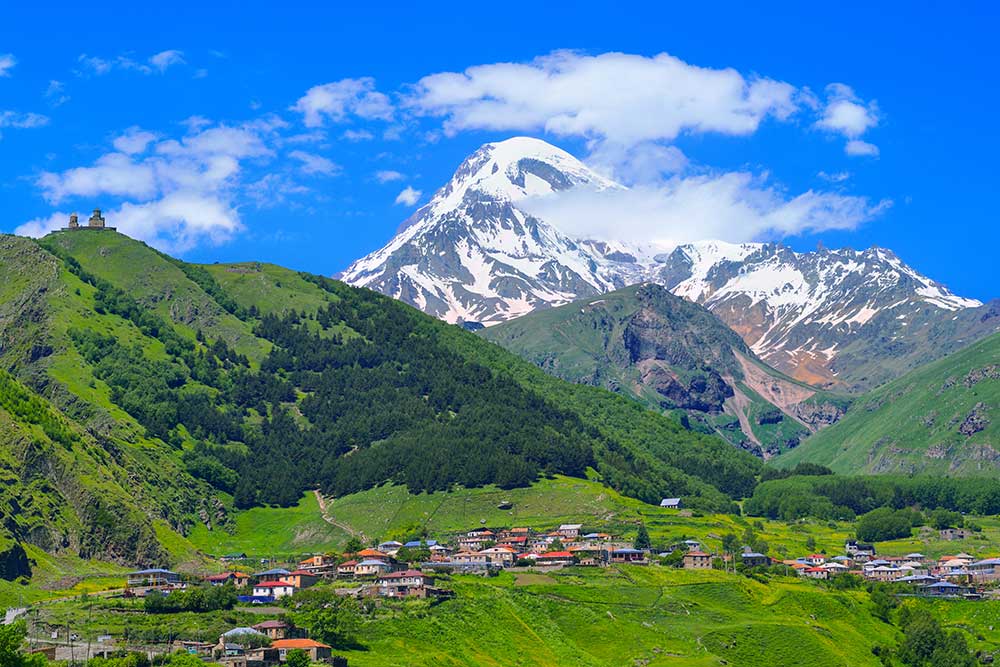
Kazbegi is one of Georgia’s most spectacular mountain destinations.
The region centers on the town of Stepantsminda, surrounded by the towering peaks of the Greater Caucasus.
Its most famous landmark is Gergeti Trinity Church, a 14th-century church positioned high above the valley with Mount Kazbek rising in the background.
The journey from Tbilisi follows the Georgian Military Highway, passing reservoirs, mountain viewpoints and historical attractions.
Visitors can enjoy scenic drives, short walks and longer hiking routes depending on the season and their level of experience.
Don’t miss: Gergeti Trinity Church, Mount Kazbek viewpoints and the Dariali Gorge.
Kazbegi is an excellent choice for travelers who want to experience the Caucasus Mountains without committing to a multi-day trek.
4. Ananuri Fortress — A Historic Castle Above a Reservoir
Best for: History, photography and scenic stops
Recommended time: 30–60 minutes
Best time: Spring to autumn
Ananuri is a medieval fortress complex overlooking the Zhinvali Reservoir.
Its defensive towers, churches and stone walls create a striking contrast with the surrounding mountains and turquoise water.
Ananuri was historically associated with the Dukes of Aragvi and remains one of the most recognizable landmarks along the Georgian Military Highway.
The complex is a popular stop on excursions between Tbilisi and Kazbegi.
Don’t miss: The fortress churches and panoramic views across Zhinvali Reservoir.
Combine Ananuri with Gudauri and Kazbegi rather than planning a separate full-day visit.
5. Gudauri — Mountain Scenery and Winter Sports
Best for: Skiing, snowboarding and mountain viewpoints
Recommended time: Half day to several nights
Best time: Winter for skiing; summer for mountain scenery
Gudauri is one of Georgia’s best-known mountain resorts, located along the Georgian Military Highway.
During winter, it attracts skiers and snowboarders looking for mountain slopes and spectacular Caucasus scenery.
In warmer months, Gudauri offers panoramic views, scenic drives and outdoor activities operated according to local conditions.
The nearby Russia–Georgia Friendship Monument, often called the Gudauri Panorama, is a particularly popular viewpoint.
Don’t miss: Gudauri Panorama and the surrounding Greater Caucasus landscapes.
Winter visitors should check snow conditions and road restrictions before traveling.
6. Truso Valley — A Hidden Gem Near Kazbegi
Best for: Nature, hiking and remote landscapes
Recommended time: Half to full day
Best time: Summer and early autumn
Truso Valley is one of the most beautiful lesser-known places in the Kazbegi region.
The valley is known for mineral springs, travertine formations, abandoned settlements and dramatic mountain scenery.
Unlike the popular Gergeti Trinity Church viewpoint, Truso offers a quieter experience for travelers who enjoy exploring on foot.
Access involves rough roads and, depending on your chosen route, considerable walking.
The valley lies in a sensitive border region, so travelers should check current access regulations and carry identification.
Don’t miss: Mineral springs, travertine terraces and the valley’s traditional stone architecture.
Truso is best suited to visitors who have additional time in Kazbegi and are comfortable with more adventurous travel.
Best Places to Visit in Kakheti: Georgia’s Wine Region
7. Sighnaghi — The City of Love
Best for: Romantic scenery, wine and historic streets
Recommended time: Half day or overnight
Best time: Spring and autumn
Sighnaghi is a picturesque hilltop town overlooking the Alazani Valley.
Its colorful buildings, narrow streets and surviving defensive walls make it one of eastern Georgia’s most photogenic destinations.
The surrounding region is known for traditional wineries, family-run guesthouses and beautiful views toward the Greater Caucasus Mountains.
Nearby Bodbe Monastery adds an important cultural and religious stop.
Don’t miss: Sighnaghi’s town walls, Alazani Valley viewpoints and Bodbe Monastery.
Sighnaghi is especially attractive during the autumn wine harvest season.
8. Telavi — The Cultural Heart of Kakheti
Best for: Wine tourism, history and regional culture
Recommended time: Half day to one night
Best time: Spring and autumn
Telavi is one of Kakheti’s most important historical and cultural centers.
The town offers a more everyday perspective on life in Georgia’s wine region than some of the smaller, tourism-focused villages.
Visit the historic Batonis Tsikhe fortress complex, explore local markets and discover nearby churches and wineries.
Telavi is also a useful base for visiting Alaverdi Monastery, Ikalto and the wider Alazani Valley.
Don’t miss: Batonis Tsikhe and nearby traditional wineries.
For travelers planning several days in Kakheti, Telavi provides a practical overnight base.
9. Tsinandali Estate — Georgian Wine and Aristocratic Heritage
Best for: Wine, gardens, culture and history
Recommended time: 1–2 hours
Best time: Spring to autumn
Tsinandali Estate is associated with Prince Alexander Chavchavadze, an important figure in Georgian cultural history.
The estate combines a historical residence, landscaped gardens and the heritage of Georgian winemaking.
Visitors can learn about the estate’s history while exploring its grounds and wine-related attractions.
The site is also associated with the Tsinandali classical music festival.
Don’t miss: The historical house museum, gardens and wine heritage.
Tsinandali is a natural addition to a Kakheti itinerary that includes Telavi.
10. David Gareja — Monasteries in a Semi-Desert Landscape
Best for: Unique landscapes, religious history and photography
Recommended time: Half to full day
Best time: Spring and autumn
David Gareja is one of Georgia’s most distinctive historical landscapes.
Located in the semi-desert hills of southeastern Georgia, the monastery complex includes rock-cut religious structures, caves and historically significant frescoes.
The surrounding scenery feels remarkably different from the country’s green mountain and forest regions.
Parts of the wider monastic complex lie near the Georgia–Azerbaijan border, where access can be restricted or subject to change.
Don’t miss: Lavra Monastery and the surrounding semi-desert landscapes.
Before visiting, confirm which sections are open. Do not assume that all caves, trails or monastery areas are accessible.
Best Historical Places in Central Georgia
11. Uplistsikhe — An Ancient Rock-Cut City
Best for: Archaeology, history and unusual architecture
Recommended time: 1–2 hours
Best time: Spring and autumn
Uplistsikhe is an ancient rock-cut settlement near Gori and one of Georgia’s most remarkable archaeological sites.
Its oldest sections date back to pre-Christian antiquity.
Visitors can walk through rock-cut streets, chambers, ceremonial spaces and the remains of structures that reflect the site’s long history.
The elevated setting provides views over the surrounding Shida Kartli landscape.
Some paths involve uneven rock surfaces and exposed sections.
Don’t miss: The ancient rock-cut halls, passageways and viewpoints.
Uplistsikhe can be combined with Gori and Mtskheta on a historical day trip from Tbilisi.
12. Gori — A City of Contrasting Histories
Best for: Georgian history, museums and architecture
Recommended time: 2–3 hours
Best time: Year-round
Gori is a historic city in central Georgia, best known internationally as the birthplace of Joseph Stalin.
The city is home to the Stalin Museum, which visitors interested in Soviet history may choose to explore critically and in its historical context.
However, Gori’s history extends far beyond the Soviet period.
Gori Fortress rises above the city center, reflecting the region’s much older strategic importance.
Nearby Uplistsikhe provides an opportunity to explore an entirely different period of Georgian history.
Don’t miss: Gori Fortress and the historic city center.
Gori works well as a stop when traveling between Tbilisi and western Georgia.
Best Places to Visit in Kutaisi and Western Georgia
13. Kutaisi — One of Georgia’s Oldest Cities
Best for: History, architecture and western Georgia excursions
Recommended stay: 1–2 days
Best time: Spring to autumn
Kutaisi is one of Georgia’s oldest urban centers and an important gateway to western Georgia.
Located along the Rioni River, the city has a relaxed atmosphere, traditional markets, bridges and historical landmarks.
Its central attractions include the Colchis Fountain, Bagrati Cathedral and the historic White Bridge.
Kutaisi also provides convenient access to caves, canyons and monasteries in Imereti and Samegrelo.
Don’t miss: Bagrati Cathedral, the White Bridge and the central market.
For travelers arriving at Kutaisi International Airport, the city is a convenient first stop.
14. Gelati Monastery — A UNESCO World Heritage Site
Best for: UNESCO heritage, medieval art and history
Recommended time: 1–2 hours
Best time: Year-round, subject to access conditions
Gelati Monastery is one of Georgia’s most significant medieval religious and educational complexes.
Founded in the early 12th century by King David IV, it became an important center of learning and cultural development during Georgia’s Golden Age.
The complex is recognized as a UNESCO World Heritage Site.
Its architecture, mosaics and frescoes reflect the artistic achievements of medieval Georgia.
Don’t miss: The monastery architecture and surviving historical artworks, where visitor access permits.
Conservation work may affect access to individual areas. Check the latest visiting arrangements before departure.
15. Prometheus Cave — An Underground Natural Wonder
Best for: Families, geology and nature
Recommended time: 1–2 hours
Best time: Year-round, subject to operating conditions
Prometheus Cave, located near Tskaltubo, is one of western Georgia’s most popular natural attractions.
The cave contains impressive stalactites, stalagmites, underground chambers and unusual rock formations.
A developed visitor route allows travelers to explore selected sections of this extensive cave system.
The underground environment provides an interesting contrast to Georgia’s outdoor mountain and forest attractions.
Don’t miss: The illuminated cave chambers and geological formations.
Wear comfortable footwear and bring a light outer layer, as underground temperatures can feel cool.
16. Martvili Canyon — Turquoise Water and Limestone Cliffs
Best for: Nature, photography and scenic walks
Recommended time: 1–2 hours
Best time: Spring to autumn
Martvili Canyon is one of western Georgia’s most photogenic natural attractions.
Located in Samegrelo, the canyon features clear water, limestone cliffs and lush vegetation.
Visitors can explore the designated walking route and, when conditions permit, participate in a boat excursion.
The combination of water and surrounding greenery makes Martvili especially attractive during the warmer months.
Don’t miss: The canyon viewpoints and official boat experience when operating.
Boat services may be suspended because of water levels, weather or safety requirements. Check with the Agency of Protected Areas before traveling.
17. Okatse Canyon — A Walk Above the Gorge
Best for: Scenic walks, viewpoints and adventure
Recommended time: 2–3 hours
Best time: Spring to autumn
Okatse Canyon is known for its dramatic suspended walkway above a forested gorge.
The route passes through woodland before reaching elevated platforms overlooking the canyon.
The experience is particularly appealing to visitors looking for a more active excursion than ordinary sightseeing.
The walking route requires suitable footwear and may be unsuitable for visitors with significant mobility difficulties or a strong fear of heights.
Don’t miss: The hanging walkway and panoramic viewing platform.
Check the official operating conditions and visitor restrictions before departure.
Best Places to Visit in Svaneti
18. Mestia — Gateway to the Svaneti Mountains
Best for: Mountain culture, hiking and traditional architecture
Recommended stay: 2–3 days
Best time: Summer and early autumn; winter for selected activities
Mestia is the principal tourism center of Upper Svaneti.
Surrounded by dramatic Caucasus peaks, the town is famous for its medieval defensive towers and distinctive Svan culture.
It offers museums, mountain viewpoints, traditional guesthouses and access to some of Georgia’s best-known hiking routes.
Popular excursions include trails toward alpine viewpoints, nearby villages and routes into the surrounding valleys.
Don’t miss: Traditional Svan towers, mountain views and the Svaneti Museum of History and Ethnography.
Mestia is best enjoyed as part of a multi-day trip rather than a quick excursion from Tbilisi.
19. Ushguli — Medieval Villages Beneath Mount Shkhara
Best for: UNESCO heritage, mountain villages and photography
Recommended time: Full-day excursion from Mestia or overnight
Best time: Summer and early autumn
Ushguli is a group of traditional high-altitude villages in Upper Svaneti.
Its medieval towers, stone houses and mountain setting create one of the most recognizable cultural landscapes in Georgia.
Upper Svaneti is a UNESCO World Heritage property, recognized for its distinctive medieval settlement patterns and tower houses.
Ushguli lies beneath the dramatic mountains of the Greater Caucasus, including nearby Mount Shkhara.
Don’t miss: The traditional villages, defensive towers and mountain views.
The road from Mestia can be rough or restricted by weather. Check current access conditions before traveling.
Best Places to Visit on Georgia’s Black Sea Coast
20. Batumi — Georgia’s Black Sea City
Best for: Coastal holidays, modern architecture and city entertainment
Recommended stay: 2–3 days
Best time: Late spring to early autumn for outdoor sightseeing
Batumi is Georgia’s best-known Black Sea resort city.
The city combines a long seaside boulevard, modern architecture, historic streets, gardens and a lively restaurant scene.
Visitors can walk along Batumi Boulevard, explore Europe Square, visit the Alphabet Tower and enjoy the city’s beaches.
The subtropical coastal setting creates a different atmosphere from inland Georgia.
Don’t miss: Batumi Boulevard, the Alphabet Tower, Europe Square and the Botanical Garden.
Batumi is particularly popular in summer, although the city can be explored throughout the year.
21. Mtirala National Park — Subtropical Forest Adventures
Best for: Forest walks, waterfalls and ecotourism
Recommended time: Half to full day
Best time: Late spring to early autumn
Mtirala National Park offers a very different experience from Georgia’s alpine mountain regions.
Located in Adjara, it is known for its humid forests, dense vegetation, streams and waterfalls.
Visitors can explore designated trails and experience the natural environment characteristic of western Georgia.
The wider Colchic rainforest ecosystems of the region have international conservation significance.
Don’t miss: Forest trails and waterfalls accessible through the park’s designated routes.
Rain is common, so suitable walking shoes and waterproof clothing are advisable.
22. Kobuleti Protected Areas — Georgia’s Remarkable Wetlands
Best for: Nature, biodiversity and quieter coastal experiences
Recommended time: 1–2 hours or longer for nature enthusiasts
Best time: Spring to autumn
Kobuleti Protected Areas offer an opportunity to discover Georgia’s distinctive wetland ecosystems.
The area is known for peatlands and rare natural habitats that differ greatly from the country’s better-known mountain destinations.
These environments form part of the wider Colchic wetland heritage recognized for its ecological importance.
For travelers interested in biodiversity, conservation and nature photography, Kobuleti provides a worthwhile alternative to the busier beaches nearby.
Don’t miss: Designated nature observation areas and wetland landscapes.
Check current visitor access and available trails before traveling.
Best Places to Visit in Southern Georgia
23. Borjomi — Mineral Springs and Forested Mountains
Best for: Nature, relaxation and forest walks
Recommended stay: 1–2 days
Best time: Spring to autumn
Borjomi is one of Georgia’s best-known resort towns, internationally associated with its mineral water.
The town is surrounded by forested hills and offers access to Borjomi Central Park, historical buildings and natural attractions.
Borjomi is also a gateway to Borjomi-Kharagauli National Park, where longer hiking routes offer opportunities to explore woodland and mountain environments.
Don’t miss: Borjomi Central Park and the mineral water spring.
Borjomi can be combined with Bakuriani, Rabati Castle or Vardzia during a southern Georgia itinerary.
24. Bakuriani — A Mountain Resort for Every Season
Best for: Winter sports, families and mountain relaxation
Recommended stay: 1–3 days
Best time: Winter for snow activities; summer for mountain escapes
Bakuriani is a well-established Georgian mountain resort known for winter recreation.
Its forested setting and range of slopes make it particularly popular with families and visitors looking for a mountain holiday.
During warmer months, the surrounding area offers opportunities for walking, cycling and enjoying cooler mountain air.
Don’t miss: The resort’s mountain landscapes and seasonal outdoor activities.
Check current slope operations, lift availability and weather conditions before arranging a winter sports trip.
25. Rabati Castle, Akhaltsikhe — A Fortress of Layered History
Best for: Architecture, history and cultural heritage
Recommended time: 1–2 hours
Best time: Spring to autumn
Rabati Castle is a prominent fortress complex in the city of Akhaltsikhe.
The site reflects different periods of Georgia’s history and includes defensive structures, religious buildings, courtyards and exhibition spaces.
Its restored architecture makes it one of the most visually recognizable attractions in southern Georgia.
Don’t miss: The fortress towers, courtyards and elevated viewpoints.
Akhaltsikhe is a convenient stop on a route connecting Borjomi with Vardzia.
26. Vardzia — Georgia’s Spectacular Cave Monastery
Best for: Medieval history, cave architecture and unusual landscapes
Recommended time: 1.5–2.5 hours
Best time: Spring to autumn
Vardzia is one of Georgia’s most extraordinary historical monuments.
This extensive cave monastery complex was carved into the cliffs of southern Georgia during the medieval period and is closely associated with Queen Tamar and Georgia’s Golden Age.
Visitors can explore rock-cut chambers, passages, stairways and religious spaces.
The sheer scale of the settlement is especially impressive when viewed from the opposite side of the valley.
Don’t miss: The rock-cut monastery structures and panoramic views of the entire complex.
Some sections involve steep stairs, narrow passages and uneven surfaces.
Vardzia is included on Georgia’s UNESCO Tentative List; it is not currently an inscribed UNESCO World Heritage Site.
27. Paravani Lake — A Peaceful Highland Landscape
Best for: Scenic road trips, photography and quiet landscapes
Recommended time: Brief stop to half day
Best time: Late spring to early autumn
Paravani Lake is a large high-altitude lake on the Javakheti Plateau in southern Georgia.
Its broad open landscapes and surrounding grasslands create a striking contrast with the forested valleys of western Georgia.
The area is particularly appealing to travelers who enjoy wide horizons, remote scenery and less crowded destinations.
Weather can be windy and cool, even during warmer months.
Don’t miss: The lake’s panoramic views and the surrounding highland scenery.
Paravani is best included as part of a planned southern Georgia road trip rather than a standalone day excursion from Tbilisi.
Georgia’s Remote Mountain Regions and Hidden Gems
28. Tusheti — Georgia’s Remote Mountain Paradise
Best for: Remote mountain adventures, hiking and traditional villages
Recommended stay: 3–5 days
Best time: Summer, subject to road conditions
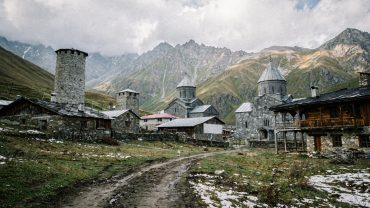
Tusheti is one of Georgia’s most remarkable and remote mountain regions.
Located in the northeastern Greater Caucasus, it is known for stone villages, medieval towers, highland traditions and expansive mountain landscapes.
Omalo is the region’s main settlement, while villages such as Dartlo and Shenako are among its most distinctive destinations.
The mountain road reaches Tusheti through Abano Pass, one of Georgia’s most demanding high-altitude routes.
Don’t miss: Omalo, Keselo towers, Dartlo and the surrounding mountain landscapes.
Road access is seasonal and can change according to snow, landslides and weather. Use an experienced local driver with a suitable vehicle, and confirm conditions before departure.
Tusheti deserves several days and should not be treated as an ordinary day trip from Tbilisi.
29. Shatili — A Medieval Fortress Village in Khevsureti
Best for: Medieval architecture, remote landscapes and adventure
Recommended stay: 1–2 nights
Best time: Summer, subject to road access
Shatili is one of Georgia’s most extraordinary historical mountain settlements.
Its tightly connected defensive stone houses and towers rise above the surrounding landscape in the remote Khevsureti region.
The village’s unusual architecture reflects the defensive traditions of the region’s mountain communities.
Shatili offers a very different experience from Georgia’s cities and established tourist resorts.
Don’t miss: The historical fortified village and surrounding mountain valleys.
The journey involves remote mountain roads, and access is highly dependent on seasonal conditions.
If time allows, travelers may also consider exploring other historical villages in Khevsureti with appropriate local arrangements.
30. Racha — Forests, Lakes and Traditional Mountain Villages
Best for: Nature, peaceful landscapes, regional food and road trips
Recommended stay: 2–3 days
Best time: Late spring to autumn
Racha is one of Georgia’s most appealing destinations for travelers looking beyond the country’s busiest tourism routes.
The region is known for forested mountains, picturesque villages, historical churches and distinctive regional cuisine.
One of its best-known attractions is Shaori Reservoir, particularly beautiful during autumn when the surrounding forests change color.
Nearby Nikortsminda Cathedral is celebrated for its medieval architecture and decorative stonework.
Visitors can also discover traditional Rachan food and local wines, including the region’s well-known Khvanchkara wine.
Don’t miss: Shaori Reservoir, Nikortsminda Cathedral and Racha’s forested mountain landscapes.
Racha is particularly rewarding for travelers who prefer a slower itinerary and want to explore an area that receives fewer international visitors than Kazbegi or Kakheti.
Best Places to Visit in Georgia by Season
Georgia’s varied geography means that the ideal destination changes throughout the year.
Spring: March to May
Spring is particularly suitable for Tbilisi, Mtskheta, Kakheti, Kutaisi, Martvili Canyon and David Gareja.
Mild conditions in many lowland areas make this a rewarding season for cultural sightseeing and nature excursions.
Some mountain destinations may still have snow or restricted access.
Summer: June to August
Summer is an excellent period for Svaneti, Kazbegi, Tusheti, Khevsureti and the Black Sea coast.
High-altitude destinations are particularly attractive for hiking and escaping the heat of lower-elevation cities.
Some mountain roads may remain closed into early summer or temporarily close after severe weather.
Autumn: September to November
Autumn is one of the most attractive seasons for Kakheti, Tbilisi, Racha, Borjomi and historical sightseeing.
September and October are particularly appealing for wine tourism and the traditional Rtveli grape harvest.
Winter: December to February
Winter is ideal for Gudauri, Bakuriani and selected mountain resort activities.
Tbilisi and other major cities remain attractive for cultural trips, restaurants, museums and winter celebrations.
Travel to remote mountain villages may be restricted.
Do You Need to Rent a Car in Georgia?
No. You can visit many of Georgia’s most popular destinations without renting a car.
Public transport, guided tours and private transfers allow travelers to explore major cities, historical sites and mountain regions.
However, renting a car can provide greater flexibility for independent road trips.
Vehicles drive on the right-hand side of the road.
Check driving licence requirements, rental insurance conditions and road restrictions before collecting your vehicle.
Mountain roads require particular care during snow, heavy rain and periods of low visibility.
For current road information, consult the Roads Department of Georgia.
How to Plan a Georgia Itinerary Around These Destinations
You do not need to visit all 30 places in one trip.
A well-planned route focusing on nearby regions is usually more enjoyable than trying to cover the entire country.
3–4 Days: First-Time Georgia Highlights
Spend two days discovering Tbilisi, followed by a day trip to Mtskheta and either Kazbegi or Kakheti.
This itinerary provides a combination of city sightseeing, history and Georgia’s distinctive landscapes.
5–7 Days: Tbilisi, Mountains and Wine
Combine Tbilisi with Mtskheta, Kazbegi and Kakheti.
If you have an additional day, consider Uplistsikhe or another historical destination in central Georgia.
8–10 Days: Eastern and Western Georgia
Explore Tbilisi, Mtskheta, Kazbegi and Kakheti before traveling toward Kutaisi.
Spend time discovering Gelati Monastery, Prometheus Cave and Martvili Canyon.
Depending on your interests and available time, continue toward Batumi or Borjomi.
12–14 Days: A Broader Georgia Adventure
With approximately two weeks, you can combine major destinations in eastern Georgia with Kutaisi, the Black Sea coast and selected mountain regions.
However, adding Svaneti, Tusheti or Khevsureti requires careful consideration of travel time.
For a relaxed itinerary, choose one major remote mountain region instead of trying to include all of them.
Practical Tips for Visiting Georgia’s Top Attractions
Before visiting the destinations in this guide, keep several practical considerations in mind.
- Check road conditions: Mountain routes can close because of snow, landslides or severe weather.
- Allow realistic travel time: Mountain driving can take significantly longer than the distance suggests.
- Wear suitable footwear: Cave cities, monasteries and natural attractions often have uneven surfaces.
- Respect religious sites: Dress requirements and photography restrictions may apply.
- Check opening hours: Museums, protected areas and visitor attractions may operate seasonally.
- Carry some cash: Card payment facilities can be limited in remote villages.
- Download offline maps: Mobile coverage is not guaranteed in every mountain valley.
- Travel responsibly: Follow marked trails and protected-area regulations.
Frequently Asked Questions
Kazbegi and Svaneti are among Georgia's most spectacular mountain destinations, while Kakheti is known for its vineyards and historic towns. The best choice depends on whether you prefer mountains, culture, wine or coastal scenery.
Tbilisi, Mtskheta, Kazbegi and Kakheti offer an excellent introduction to Georgia. These destinations combine historical landmarks, natural scenery, traditional cuisine and wine culture.
Seven to ten days is a practical starting point for exploring several major destinations. Travelers who want to include remote mountain regions or both eastern and western Georgia may benefit from 12–14 days or longer.
Yes. Trains, intercity buses, taxis, guided tours and private transfers connect many of Georgia's popular destinations. However, remote places such as Tusheti and Shatili require more specialized transportation arrangements.
The best places to visit in Georgia reflect the remarkable diversity of this small Caucasus country.
From Tbilisi's historic streets and Mtskheta's medieval monuments to Kazbegi's dramatic mountain scenery, Kakheti's wine traditions and Svaneti's ancient towers, every region offers a different perspective on Georgia.
If you're visiting for the first time, start with Tbilisi, Mtskheta, Kazbegi and Kakheti. If you have more time, continue toward western Georgia, explore the country's historical cave cities or plan a multi-day adventure in the mountains.
At Gamarjoba Georgia Tours, we help travelers discover Georgia through local experiences, cultural sightseeing and carefully planned excursions.
Explore our group tours and private tours to start planning your Georgian adventure.
Table of Contents
Recommended



Comment (0)