
Georgia Travel Guide for First-Time Visitors: What to Know in 2026
- August 4, 2026
A Georgia travel guide for first-time visitors needs to explain more than where to photograph churches, eat khinkali or see the Caucasus. The details that usually determine whether a trip works well are less glamorous: entry documents, travel insurance, realistic driving times, mountain road conditions, payment habits and choosing an itinerary that does not treat the country like a compact city break.
Georgia is not physically enormous, but it is geographically complicated. A route that looks short on a map may cross a mountain pass, follow a narrow valley or depend on a road affected by snow, landslides or construction. The most useful first-trip plan is therefore not the one with the longest list of places. It is the one that allows enough time to understand each region without spending most of the holiday inside a vehicle.
Georgia entry requirements for first-time visitors
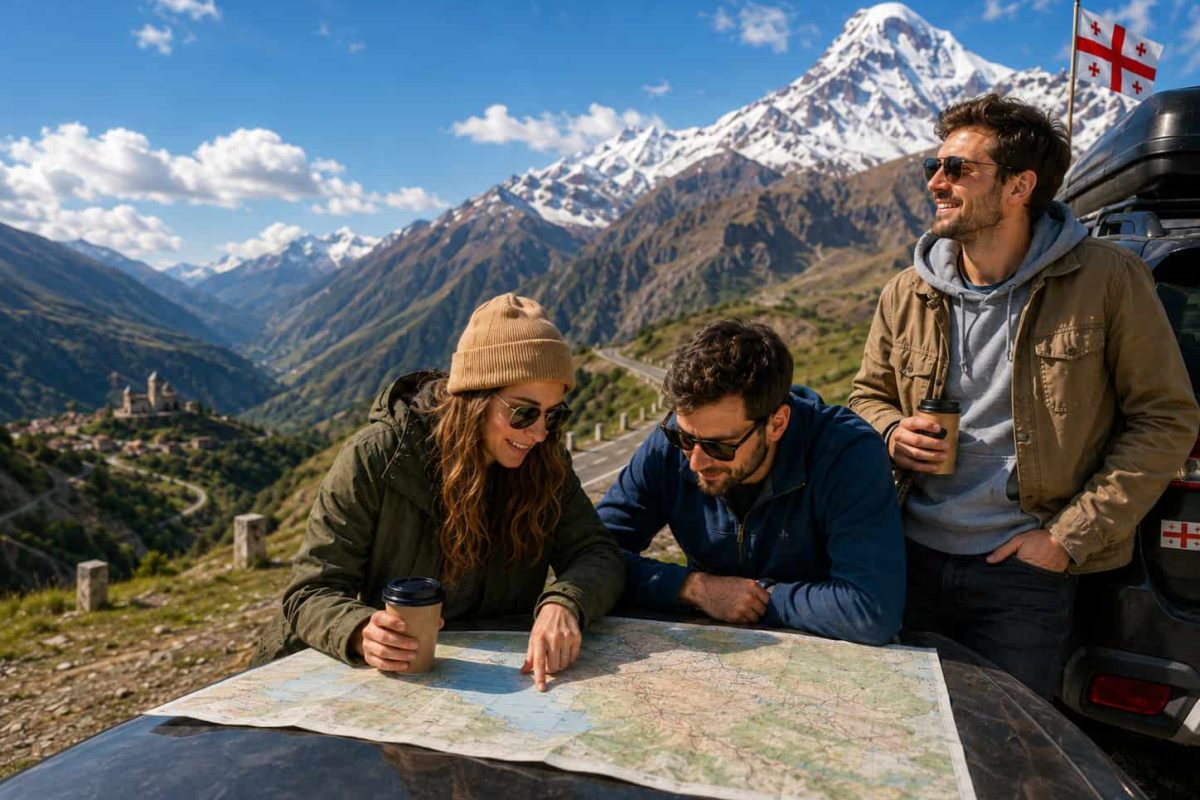
Before buying flights, check the rules that apply to your passport through Georgia’s official GeoConsul portal. Georgia allows citizens of many countries to enter without a visa, in numerous cases for stays of up to one year, but the exact entitlement depends on nationality, travel document and purpose of visit. Visa-free admission as a tourist does not automatically authorise employment, study or every form of long-term residence.
Your passport should remain valid for the journey, and it is sensible to carry evidence of accommodation, onward travel and sufficient funds even when these documents are not routinely requested. Border officers retain the authority to assess whether a traveller meets the conditions of entry.
Travellers who require a visa should use the official Georgian consular or electronic visa system rather than an unofficial intermediary. Requirements may differ according to citizenship and residence status, so generic statements such as “everyone can enter Georgia visa-free” should not be trusted.
Mandatory travel insurance in Georgia from 2026
The most important recent change for a first trip to Georgia is the introduction of mandatory health and accident insurance.
Since 1 January 2026, tourists entering Georgia must hold a valid health and accident insurance policy for the entire duration of their stay, including the arrival and departure dates. The policy may be issued by a Georgian or foreign insurer, must provide coverage of at least 30,000 GEL, and must be available in Georgian or English. Travellers may present it electronically or as a printed document. Limited exemptions apply to certain diplomatic, official and international-transport categories.
Do not rely only on a generic confirmation email from a bank card or booking platform. Check that the document clearly shows:
- the insured traveller’s details;
- the territory covered;
- the beginning and end of coverage;
- insured health and accident risks;
- the coverage limit;
- the insurer and policy information.
People planning skiing, horse riding, trekking, paragliding or travel at high altitude should also examine exclusions. A policy may satisfy the entry requirement but still exclude the activity most likely to cause an expensive rescue or medical claim.
How many days do you need for a first trip to Georgia?
For most travellers, seven to ten days is a practical starting point. It provides enough time to see Tbilisi and add two contrasting regions without turning the trip into a continuous transfer.
A sensible first itinerary could combine:
- Tbilisi and Mtskheta for urban history, architecture, food and the country’s religious heritage.
- Kakheti for vineyards, small towns, monasteries and wine culture.
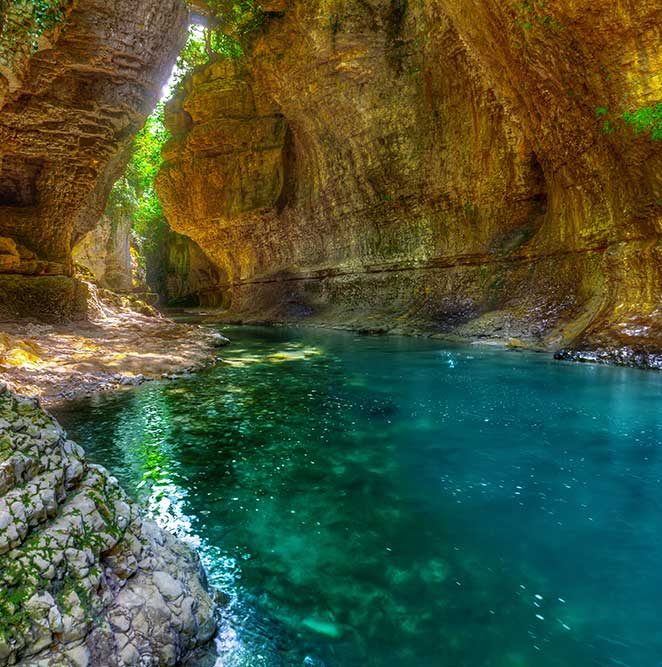
- Kazbegi or the Kutaisi region for mountain scenery or western Georgia’s caves, canyons and monasteries.
With two weeks, it becomes more realistic to include Svaneti, the Black Sea coast, Samtskhe-Javakheti or a longer hiking section. Trying to combine Tbilisi, Kazbegi, Kakheti, Kutaisi, Mestia, Ushguli and Batumi in one week is technically possible only if the purpose of the trip is to collect road kilometres.
Choose regions according to the season
Georgia does not have one uniform travel season. Conditions in Tbilisi, Kakheti, Batumi and the Greater Caucasus can differ substantially on the same date.
Spring and autumn work well for cities, wine regions and lower-altitude cultural routes. Summer offers broader access to high-mountain villages and hiking trails, although Tbilisi and eastern lowlands can feel hot. Winter suits skiing and city travel, but some mountain roads and hiking routes may be inaccessible.
Weather is only one factor. The Roads Department regularly publishes temporary restrictions caused by snow, avalanche risk, rockfall, construction and poor visibility. Mountain access should therefore be checked shortly before departure rather than assumed from previous-year travel blogs.
Getting around Georgia for the first time
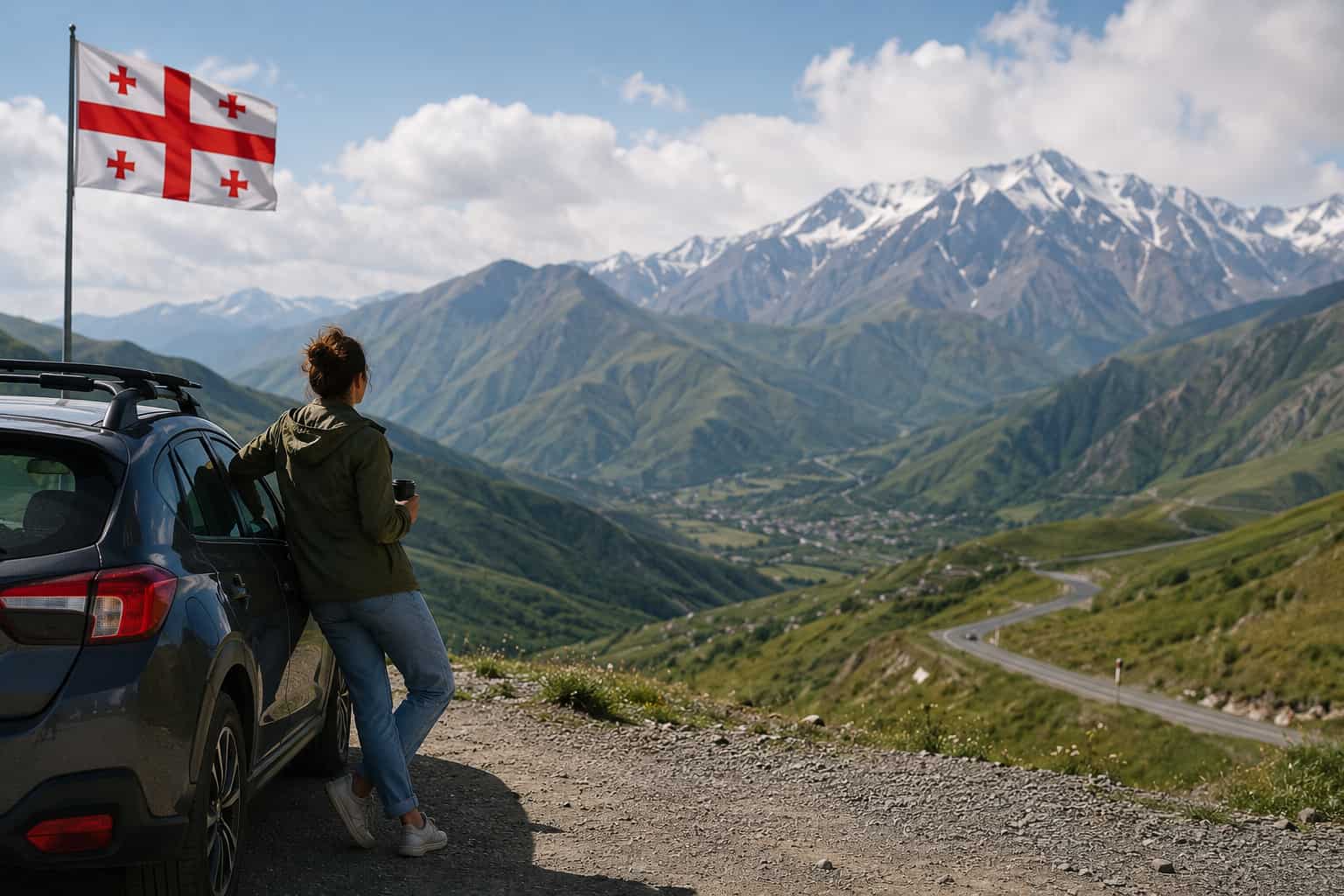
Georgia has trains, buses, minibuses, domestic flights, taxis, rental vehicles and private transfers. No single option is best for every route.
Trains
Rail is useful on selected connections, particularly between major cities. It is generally more comfortable than a minibus, but the network does not reach the main mountain destinations. Book popular services in advance during busy periods and check the departure station carefully because Tbilisi has more than one transport terminal.
Marshrutkas and intercity minibuses
Marshrutkas are inexpensive and cover many routes that trains do not. Their disadvantages are limited luggage space, variable comfort, less predictable departure practices and driving standards that may feel unfamiliar to visitors.
They are suitable for flexible travellers with light luggage. They are less convenient for families, travellers carrying hiking equipment or anyone trying to connect directly with a flight.
Rental cars
A rental car offers flexibility in Kakheti, Samtskhe-Javakheti and many rural areas. It also requires confidence with local driving behaviour, mountain roads, animals on the carriageway and uneven surfaces.
A standard car may be sufficient for paved regional routes. It should not be treated as a substitute for a proper high-clearance or four-wheel-drive vehicle on rough mountain roads. Rental agreements and insurance conditions should be checked before leaving paved roads.
Private drivers and tours
A driver or organised tour costs more than public transport but removes several common problems: finding rural connections, handling luggage, navigating road closures and deciding whether conditions are safe.
This is often the practical choice for Kazbegi, remote Kakheti wineries, highland villages and routes with multiple stops.
Money, cards and currency exchange
Georgia’s national currency is the Georgian lari, abbreviated GEL. The official exchange rate published by the National Bank is indicative; commercial banks and exchange offices set their own buying and selling rates. The National Bank also provides current commercial-bank comparisons, which are more useful than assuming every exchange counter offers the same deal.
Cards are useful in cities, hotels, supermarkets and many restaurants. Cash remains important for:
- village guesthouses;
- small markets and bakeries;
- marshrutkas;
- roadside stalls;
- tips and small purchases;
- remote mountain settlements.
Check both the displayed exchange rate and any commission before handing over money. Airport exchange desks are convenient, but convenience does not necessarily mean the best rate.
Avoid carrying only large banknotes. Small businesses may struggle to provide change, particularly early in the day or outside major cities.
Mobile internet and navigation
Buying a local SIM or eSIM is usually worthwhile, especially for travellers using taxis, navigation apps and accommodation messaging. Coverage can weaken in mountain valleys even when a provider performs well in cities.
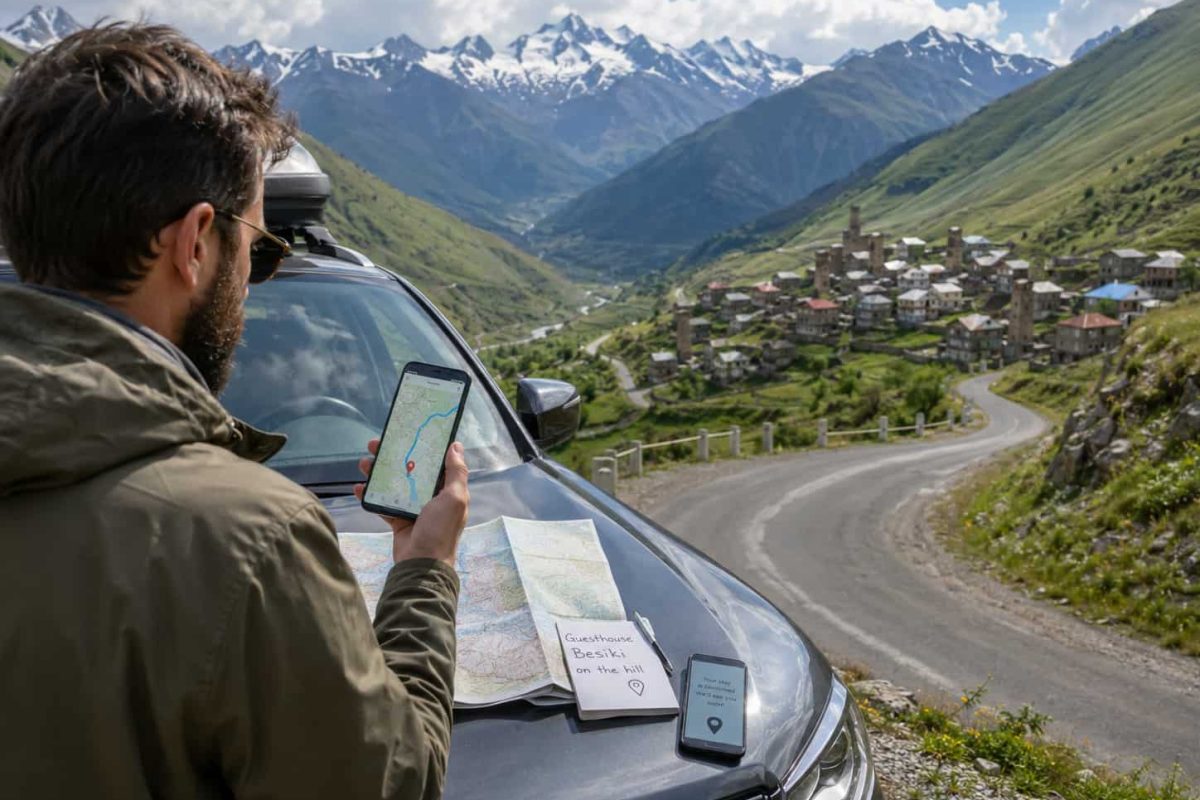
Download offline maps before travelling to remote areas. A blue line on a navigation app does not prove that the road is suitable for an ordinary vehicle, open in the current season or safe after heavy rain.
Send the accommodation name and exact location to a driver rather than relying only on a street address. Villages may contain similarly named guesthouses, and transliteration from Georgian can vary.
Is Georgia safe for first-time visitors?
Georgia is generally treated by several government travel-advice services as a destination where normal safety precautions are appropriate, but that does not remove regional and political risks.
Current travel advice warns visitors to avoid demonstrations and large political gatherings, particularly around central Tbilisi, because tensions and transport disruption can develop with little notice. Travellers should monitor local information rather than walking through a crowd simply because it blocks the shortest route to their hotel.
Foreign travel advisories strongly warn against travel to the Russian-occupied regions of Abkhazia and South Ossetia, as well as unnecessary travel near their administrative boundary lines. These boundaries may be poorly marked. Entering Georgia through these territories from the Russian side can also breach Georgian law.
For police, ambulance or fire and rescue services, call 112. The number works throughout Georgia, and operators can handle calls in Georgian, English, Russian and several regional languages. Georgia’s official 112 mobile application can also transmit location information when GPS is enabled.
Medicines and customs rules
Do not assume that medicine legally obtained in your home country can be carried into Georgia without restrictions. Georgia’s Revenue Service publishes guidance on prohibited and permitted medicines, passenger declarations and customs procedures.
Keep prescription medicines:
- in their original packaging;
- in quantities appropriate for the trip;
- with a prescription or doctor’s letter;
- in hand luggage when medically necessary;
- declared whenever Georgian customs rules require it.
This deserves particular attention for strong painkillers, sedatives, psychotropic medication and substances subject to narcotics controls.
Georgian food and restaurant etiquette
Georgian meals are often designed for sharing. Ordering one dish per person can produce far more food than expected because salads, khachapuri, vegetables, meat dishes and bread usually arrive for the table.
Khinkali are normally eaten by hand. Hold the dumpling by its twisted top, bite carefully and drink the broth before eating the rest. Leaving the doughy top on the plate is common rather than impolite.
At a traditional supra, a tamada leads the toasts. Guests are not required to match every person drink for drink. It is acceptable to sip, decline additional alcohol or choose a non-alcoholic drink.
Service charges vary. Some restaurants add a percentage to the bill, but this may not always function as a direct tip for the server. Read the bill before deciding whether to leave additional cash.
What to pack for a first trip to Georgia
A useful Georgia packing list depends more on the route than on the month printed on the ticket.
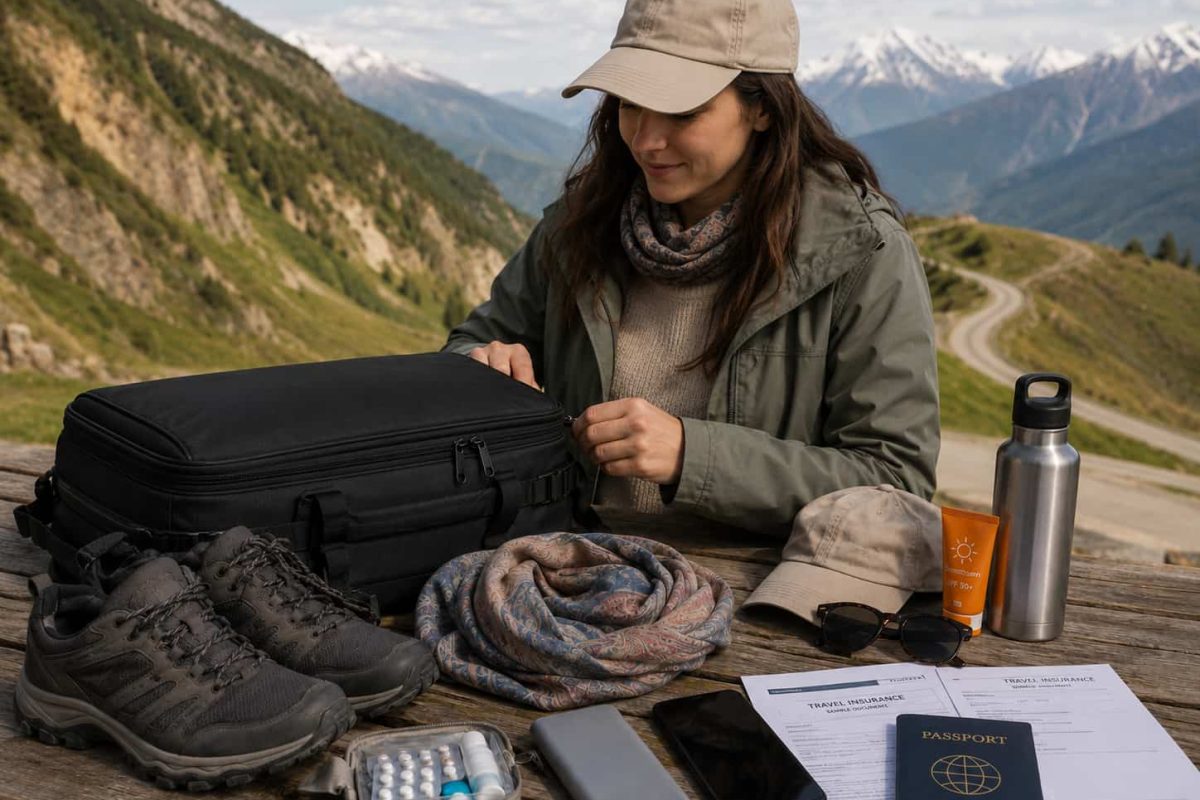
For a mixed city and mountain itinerary, bring:
- comfortable shoes with reliable grip;
- a light waterproof layer;
- clothing that can be layered;
- sun protection;
- a reusable water bottle;
- a small amount of cash;
- a power bank;
- offline copies of travel documents;
- insurance details;
- any required medication documentation.
Visitors entering Orthodox churches should wear respectful clothing. At major religious sites, coverings may be available, but carrying a light scarf is simpler than relying on what will be provided.
Common first-trip mistakes
The most common planning errors are not complicated:
- adding too many distant regions;
- trusting map distance instead of road conditions;
- booking a mountain route without checking seasonal access;
- arriving without compliant travel insurance;
- carrying no cash outside Tbilisi;
- assuming every guesthouse accepts late-night check-in;
- arranging a marshrutka connection too close to a flight;
- packing city shoes for mountain terrain;
- entering demonstrations out of curiosity;
- following an unverified shortcut near a border or administrative boundary.
A good first trip leaves room for delays. Georgia rewards flexible travel more than minute-by-minute scheduling.
Georgia travel guide for first-time visitors: final checklist
Before departure, confirm:
- Your passport and visa status.
- Insurance coverage of at least 30,000 GEL for the complete stay.
- Your first accommodation and airport transfer plan.
- Current road access for mountain destinations.
- Customs rules for medication.
- Offline maps and emergency contact details.
- A realistic route with fewer overnight changes.
- Both card access and a modest cash reserve.
Table of Contents
Recommended


Comment (0)