
Georgia Travel Costs in 2026: Prices, Daily Budgets, Money & Tipping
- May 20, 2026
Georgia travel costs in 2026 remain lower than in many established European destinations, but the country is no longer the ultra-cheap place described in older travel blogs.
A traveller can still eat well, use public transport and stay in a family-run guesthouse without spending heavily. At the same time, boutique hotels, fashionable Tbilisi restaurants, private mountain transfers and peak-season accommodation can push the total budget up quickly.
The realistic answer to “How much does it cost to travel in Georgia?” depends less on the country as a whole and more on three choices: where you stay, how you move between regions and how many private experiences you book.

Is Georgia still a budget-friendly destination in 2026?
Georgia is still a good-value destination, particularly for public transport, local bakeries, family guesthouses and independent regional travel.
It is not equally inexpensive in every setting. Central Tbilisi, Kakheti wine hotels, Gudauri during ski season and Batumi during peak summer can cost considerably more than Kutaisi, Gori, Telavi or a smaller regional town.
Prices have also risen. Georgia’s annual inflation reached 5.8% in June 2026. Transport prices were 16.5% higher than a year earlier, while prices in hotels, cafés and restaurants had increased by 8.4%.
The useful conclusion is not that Georgia has become expensive. It is that budgets copied from articles published five years ago are no longer reliable.
Georgia travel costs in 2026: quick overview
The following ranges are practical planning figures rather than fixed nationwide tariffs.
| Expense | Typical 2026 Price |
|---|---|
| Hostel dorm bed | 25–50 GEL |
| Basic guesthouse double room | 60–130 GEL |
| Family hotel room | Around 128 GEL average |
| Three-star hotel room | Around 191 GEL average |
| Four-star hotel room | Around 295 GEL average |
| Five-star hotel room | Around 494 GEL average |
| Bakery snack or simple khachapuri | 3–8 GEL |
| Casual café meal | 20–35 GEL per person |
| Mid-range restaurant meal | 40–70 GEL per person |
| Tbilisi metro or bus | 1 GEL |
| Tbilisi day transport pass | 3 GEL |
| Short app-based taxi ride | 4–15 GEL |
| Intercity marshrutka | Usually 10–25 GEL |
| Standard intercity train | Approximately 20–35 GEL |
| Group day tour | Around 80–150 GEL |
| Major museum or natural attraction | Approximately 10–40 GEL |
| Tourist mobile package | From around 19 GEL |
Georgia’s hotel price index shows why accommodation needs its own budget. In June 2026, the national average room price was 128 GEL at family-run hotels, 191 GEL at three-star hotels, 295 GEL at four-star hotels and 494 GEL at five-star properties. Hotel prices were 8.4% higher year on year.

Currency in Georgia and exchange rates
Georgia’s currency is the Georgian lari, identified by the code GEL and the symbol ₾.
At the time of this update, the National Bank of Georgia listed an indicative official rate of approximately:
- 1 USD = 2.6285 GEL;
- 1 EUR = approximately 3 GEL;
- 1 GBP = approximately 3.51 GEL.
The official rate is indicative. Banks, exchange offices and card providers use their own buying and selling rates, which means the amount a traveller receives will differ slightly.
All budgets in this guide are stated primarily in GEL. Dollar equivalents are rounded and should not be treated as a guaranteed conversion.
Cost of accommodation in Georgia
Accommodation is usually the largest variable in a Georgia travel budget.
Hostels and low-cost guesthouses
A dormitory bed in Tbilisi generally costs around 25–50 GEL. Basic hostels can be cheaper outside peak periods, while design hostels in central neighbourhoods may charge more.
Booking.com’s current Tbilisi data gives an average hostel price of roughly USD 14 per night, although same-day and weekend prices can rise substantially. A recent local hostel-market review places most dorm beds between 20 and more than 50 GEL.
A basic private room in a regional family guesthouse commonly costs 60–130 GEL per room. Breakfast may be included. In hiking regions, adding dinner and breakfast can represent much better value than buying every meal separately.
Mid-range hotels
A realistic range for a comfortable small hotel or boutique guesthouse is 130–300 GEL per room, depending on location and season.
Booking.com currently reports average Tbilisi prices of approximately USD 46 for a three-star hotel and USD 84 for a four-star hotel. These averages rise for weekends, last-minute reservations and central properties.
High-end accommodation
Four- and five-star hotels commonly begin at 300–500 GEL, but well-known luxury properties can cost considerably more.
In June 2026, the national average for a five-star room was 494 GEL. Luxury averages were higher in some regions, including Tbilisi, Kakheti and Guria.

Where accommodation prices rise most
Expect higher rates during:
- July and August in Batumi;
- the winter ski season in Gudauri;
- holiday periods in Tbilisi;
- harvest season at popular Kakheti wine hotels;
- summer hiking season in Mestia and Kazbegi;
- major events, concerts and conferences.
A room that costs 120 GEL during a quiet weekday can be significantly more expensive on a summer weekend.
Cost of food and drink in Georgia
Food can remain one of the best-value parts of travelling in Georgia, provided every meal is not taken in a fashionable central restaurant.
Bakeries and inexpensive food
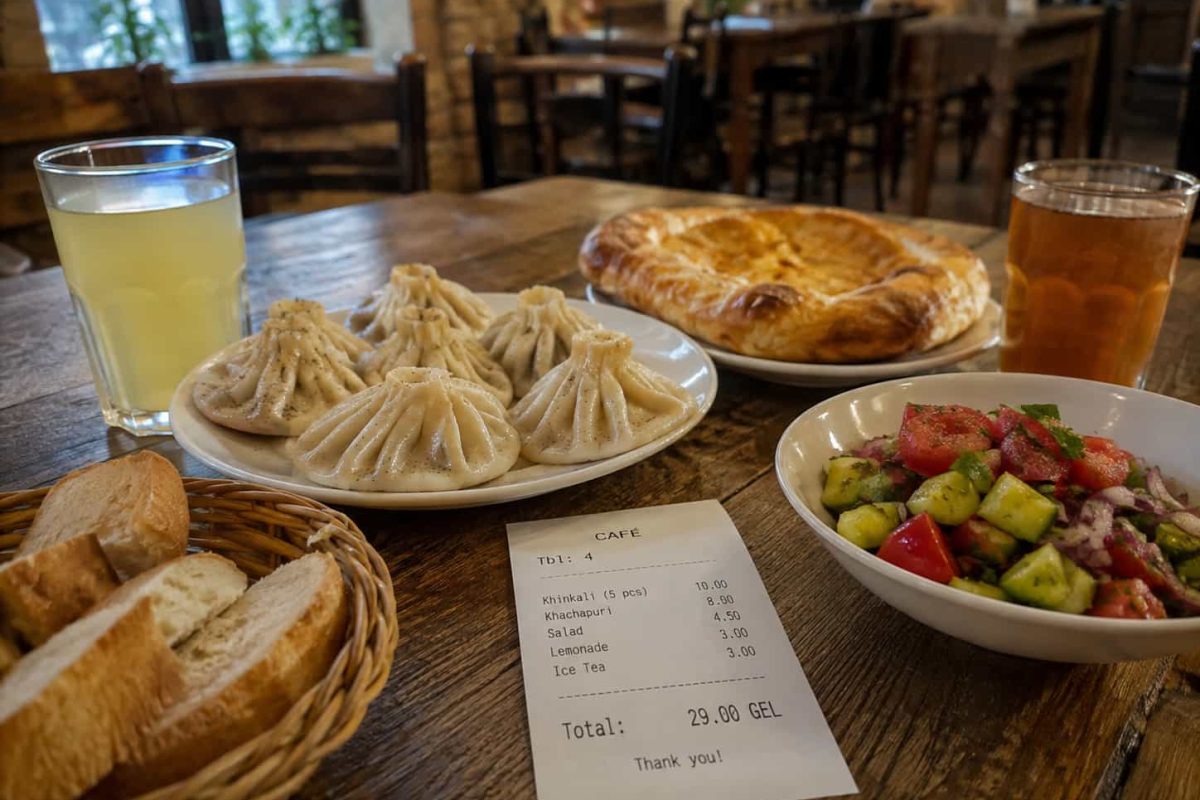
A lobiani, small khachapuri or other bakery item generally costs 3–8 GEL. These are practical breakfast, snack or light-lunch options.
A casual café meal usually costs 20–35 GEL per person. A filling order might include a main dish, bread or salad and a non-alcoholic drink.
Khinkali are usually priced individually. Around 1.5–3 GEL per dumpling is a realistic range, depending on the restaurant and filling. A Reuters Tbilisi guide recorded a price of 2 GEL per khinkali at a central restaurant in 2025.
Mid-range restaurant meals
Budget approximately 40–70 GEL per person for a proper restaurant meal with several shared dishes and a drink.
The total depends heavily on ordering habits. Georgian dishes are often designed for the table rather than one individual. A group that orders one salad, one khachapuri, khinkali and a meat or vegetable dish to share may spend less than travellers who order a separate full meal each.
Contemporary restaurants and wine bars
Modern Georgian restaurants, hotel dining rooms and specialist wine bars commonly cost 80–150 GEL or more per person, particularly when several wines are ordered.
A glass of Georgian wine in a central wine bar can cost around 8–18 GEL, while rare, aged or small-production wines cost more. Reuters recorded a price of 14 GEL for a glass of amber wine at one Tbilisi wine bar.
Groceries and self-catering
Cooking some meals can reduce costs, but grocery shopping in Georgia is not automatically extremely cheap. Imported food, specialist products and some supermarket goods may cost as much as they do elsewhere in Europe.
Markets are useful for seasonal fruit, vegetables, cheese and churchkhela. Prices should be confirmed before buying, particularly when products are sold by weight.
Cost of transportation in Georgia
Transport is inexpensive when travellers use municipal services, trains and marshrutkas. Private drivers and mountain vehicles change the calculation.
Tbilisi public transport
Tbilisi’s metro, municipal buses, minibuses and the Bagebi–University ropeway use an integrated fare system.
Current fares include:
- 1 GEL for 90 minutes of travel;
- 3 GEL for a one-day pass;
- 20 GEL for a one-week pass;
- 40 GEL for a one-month pass.
The 1 GEL fare also applies to bus 337 between Tbilisi Airport and the city. The Rike–Narikala cable car costs 2.50 GEL one way.
Taxis and ride-hailing applications
A short app-based ride in central Tbilisi usually costs around 4–8 GEL. Cross-city journeys often cost 7–15 GEL, while longer routes may reach 20–25 GEL.
An app taxi between Tbilisi Airport and the central districts commonly costs around 18–35 GEL, but rain, traffic and late-night demand can increase the price.
Use the price displayed in the application. Unmetered airport and street taxis may quote substantially higher amounts.
Marshrutkas and buses between cities
Most ordinary intercity marshrutka journeys cost approximately 10–25 GEL. Longer routes to the Black Sea coast or Svaneti may cost 30–50 GEL or more.
Typical examples include:
- Tbilisi to Gori: around 5–10 GEL;
- Tbilisi to Kazbegi: around 15 GEL;
- Tbilisi to Kutaisi: around 20 GEL;
- Tbilisi to Batumi: around 30 GEL;
- Zugdidi to Mestia: around 20–30 GEL.
Fares and departure points can change, so verify them locally. Rising fuel costs pushed some marshrutka and coach fares up by around 5 GEL during 2026.
Trains
Train travel is particularly useful between Tbilisi and Batumi and on selected western routes.
A standard ticket commonly costs around 20–35 GEL, with first and business-class options costing more. Georgian Railway’s published Tbilisi–Batumi tariff lists 34 GEL for second class, 74 GEL for first class and 124 GEL for business class.
Summer and holiday services can sell out. Georgian Railway added extra Tbilisi–Batumi departures in 2026 because of increased passenger demand.
Car rental and private drivers
An ordinary rental car often starts at roughly USD 25–50 per day, before fuel, insurance upgrades and optional equipment. A suitable SUV or four-wheel-drive vehicle costs more.
Private transport varies by route. A full-day vehicle and driver may cost 250–600 GEL or more, depending on distance, road conditions, vehicle type and whether guiding is included.
Do not compare a private mountain transfer with a standard city taxi. Routes such as Tusheti, Ushguli and remote valleys may require an appropriate vehicle and an experienced local driver.
Activities, museums and entertainment
Georgia contains many free attractions: churches, old districts, viewpoints, hiking trails and public landscapes.
Paid attractions remain relatively affordable, but foreign visitor prices at some protected areas are higher than resident prices.
Examples include:
- Rike–Narikala cable car: 2.50 GEL one way;
- Martvili Canyon: 20 GEL for a foreign adult, plus 20 GEL for the boat trip;
- Prometheus Cave: 40 GEL for a foreign adult, plus 30 GEL for the optional boat section;
- major museum tickets: commonly between 3 and 40 GEL;
- group day tours: usually around 80–150 GEL.
The Agency of Protected Areas currently lists a foreign adult entrance price of 40 GEL for Prometheus Cave and 20 GEL for Martvili Canyon.
Georgia’s National Museum uses differentiated prices at some venues. The Simon Janashia Museum, for example, lists a 40 GEL foreign-adult ticket.
Activities such as skiing, paragliding, rafting, horse riding, private wine tastings and guided mountain expeditions require a separate budget. Check whether equipment, transport, entrance tickets and insurance are included in the advertised price.

Practical travel costs tourists forget
A realistic Georgia travel budget should also include:
Mandatory travel insurance
Since 1 January 2026, tourists must carry valid health and accident insurance for their complete stay, with a minimum coverage limit of 30,000 GEL. The premium varies by provider, age, duration and coverage.
Mobile internet
A local SIM can be inexpensive. Cellfie currently offers a 14-day tourist package with 5 GB, local calls and SMS for 19 GEL. Standard monthly packages from the same provider range from 7 to 25 GEL depending on data and call allowances.
Laundry
A hostel washing machine may cost only a few lari, while hotel laundry can be priced per item and become unexpectedly expensive.
Luggage storage
Storage at a station, airport or private service should be included when arrival and check-in times do not align.
Mountain equipment
Rain gear, trekking poles, ski equipment, helmets and camping gear can add a meaningful amount to the budget. In Tusheti, for example, the Protected Areas Agency lists tent rental at 20 GEL per day and sleeping bags at 10 GEL.
Service charges
Restaurant menu prices may not always tell the full story at first glance. In May 2026, Georgia’s Competition and Consumer Agency ruled that a restaurant’s failure to show final prices inclusive of a 15% service charge was an unfair commercial practice. The agency stated that customers must be shown the final price, including applicable service charges and taxes.
The ruling is useful, but travellers should still inspect the menu and receipt.
Average Georgia travel budget per day
The figures below exclude international flights and assume ordinary travel rather than unusually discounted or last-minute bookings.
Budget traveller: 110–170 GEL per day
Approximately USD 42–65 per person.
This budget can cover:
- a hostel bed or shared basic room;
- bakery food and inexpensive local cafés;
- municipal transport;
- marshrutkas between cities;
- free and low-cost attractions;
- occasional paid museum entry.
A solo traveller using private rooms will usually fall above the lower end.
Mid-range traveller: 230–420 GEL per day
Approximately USD 88–160 per person.
This assumes two people sharing accommodation and can cover:
- a private guesthouse or three-star hotel room;
- restaurant meals and wine;
- app-based taxis;
- trains or comfortable intercity transfers;
- paid attractions;
- an occasional group tour.
A solo traveller should add more for accommodation because the room cost is not being divided.
High-end traveller: 650 GEL or more per day
Approximately USD 247 or more per person.
This can include:
- four- or five-star accommodation;
- private transfers and drivers;
- fine dining and wine experiences;
- private guiding;
- spa treatments;
- upgraded train or domestic transport options.
Luxury resort stays, private helicopters, specialist mountain expeditions and premium wine experiences can push spending far above this level.
Seven-day Georgia travel budget
Excluding international flights, a realistic seven-day budget is approximately:
| Travel Style | Seven-Day Cost per Person |
|---|---|
| Budget | 770–1,190 GEL |
| Mid-range | 1,610–2,940 GEL |
| High-end | From 4,550 GEL |
These estimates work best for a route covering Tbilisi and one or two additional regions.
Adding Svaneti, Tusheti, several private drivers or a domestic flight will increase transport costs. Staying only in Tbilisi and using municipal transport can reduce them.

Should you tip in Georgia?
Tipping in Georgia is appreciated but does not follow the strict North American system.
The Georgian tourism portal describes 10–15% as an appropriate tip for service, but it remains discretionary. Many restaurants already add a service charge.
A practical tipping guide is:
| Service | Practical Approach |
|---|---|
| Restaurant with service charge | No extra tip required |
| Restaurant without service charge | Round up or leave 5–10% for good service |
| Café or bar | Round up or leave small change |
| Taxi or Bolt | Not required; rounding up is sufficient |
| Delivery driver | 2–3 GEL is appreciated |
| Hotel porter or housekeeping | 5–10 GEL for particularly helpful service |
| Group tour guide | Around 10–20 GEL per person for a good full-day tour |
| Private guide or driver | Discretionary; base it on the length and quality of service |
Always check the bill before adding a restaurant tip. A line marked service, service charge or მომსახურება means an additional amount may already be included.
Service charge and tip are not necessarily the same thing. A service charge may go to the business rather than directly to the employee.
Managing money in Georgia
Use Georgian lari
Hotels or tour operators may quote in euros or dollars, but ordinary payments should be made in GEL.
Carry both a card and cash
Cards and contactless payments are common in Tbilisi, Batumi, Kutaisi and established tourism businesses.
Cash remains useful for:
- marshrutkas;
- village guesthouses;
- markets;
- roadside bakeries;
- mountain settlements;
- small tips;
- local drivers.
Do not travel to a remote region with no cash simply because your hotel in Tbilisi accepted Apple Pay.
Check the exchange rate and commission
The National Bank publishes the official indicative rate and current commercial-bank exchange information. Compare the rate before exchanging a large amount.
An exchange office displaying an attractive rate may apply a commission or use different buying and selling figures.
Choose GEL at payment terminals and ATMs
When a terminal or ATM offers to convert the transaction into your home currency, paying in GEL generally allows your own card provider to handle the conversion. Check your bank’s foreign transaction and cash-withdrawal fees before travelling.
Keep smaller banknotes
A 100- or 200-lari note can be difficult to use in a bakery, marshrutka or small village shop. Keep 5-, 10- and 20-lari notes for everyday spending.
How to make your Georgia travel budget go further
The biggest savings rarely come from skipping a 5 GEL coffee. They come from changing larger decisions.
1. Travel outside peak dates. Batumi, Gudauri, Kazbegi and Kakheti can be much cheaper outside their busiest periods.
2. Stay near public transport rather than directly beside the main tourist square.
3. Share dishes. Georgian restaurant portions are often intended for the whole table.
4. Use trains and marshrutkas for long transfers.
5. Combine private transport with other travellers.
6. Book mountain accommodation early. Limited supply can raise last-minute prices.
7. Check what is included. Breakfast, dinner, entrance tickets and transport can change the real value of a room or tour.
8. Read the complete restaurant bill. Avoid unintentionally paying both a service charge and a large additional tip.
9. Withdraw or exchange money before travelling to remote villages.
10. Leave space in the budget for weather changes. A closed mountain road can require another night or a different transfer.
Table of Contents
Recommended



Comment (0)