
Do You Need Travel Insurance for Georgia in 2026?
- August 4, 2026
New Entry Rules Explained
Georgia travel insurance requirements changed on 1 January 2026: tourists entering the country must now hold valid health and accident insurance covering their full stay.
The rule sounds simple, but many travellers are still unsure what kind of policy qualifies. Does ordinary travel insurance count? Can the policy come from a foreign insurer? Is credit card coverage enough? Will border officers actually ask to see it? What happens if your insurance expires while you are still in Georgia?
This guide explains what the official legislation says, what it does not say and what you should check before travelling.

Disclaimer
This article provides general travel information based on legislation and official guidance available on 3 August 2026. It is not legal, medical or insurance advice.
Insurance conditions, border procedures and eligibility rules can change. Travellers should confirm their policy directly with the insurer and check official Georgian information before departure.
Georgia travel insurance requirements: quick overview
Since 1 January 2026, tourists entering Georgia must have health and accident insurance that:
- remains valid for the complete period between entry and departure;
- provides coverage of at least 30,000 Georgian lari;
- is issued by an authorised Georgian or foreign insurance company;
- can be presented in Georgian or English;
- is available as a printed or electronic document;
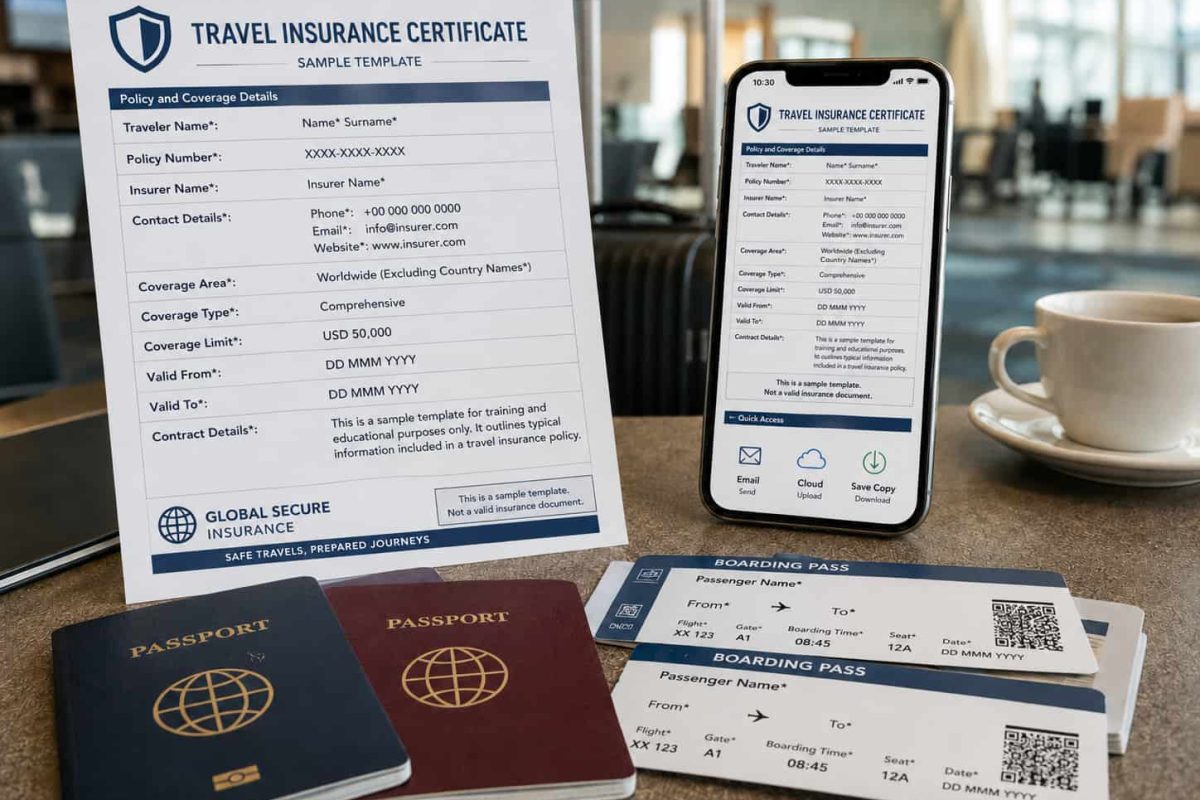
- identifies the insured risks, dates, territory, coverage limit and insurance contract details.
The legal wording refers specifically to health and accident insurance. Trip cancellation, delayed flights, lost luggage and personal belongings are useful forms of protection, but they are not identified in Government Decree No. 602 as part of the minimum entry requirement.
Early feedback from travellers
Reports from travellers during the first months of 2026 have been inconsistent.
Some people reported being asked to show proof of insurance after arriving at Tbilisi International Airport. Others said they entered through Tbilisi, Batumi or a land border without anyone requesting the document. Airlines have also reportedly issued reminders or checked insurance before departure.
These reports are anecdotal. They show that checks may not be identical for every passenger, flight or border point. They do not change the legal requirement.
The UK Foreign, Commonwealth & Development Office advises that evidence may be requested either by an airline at check-in or by Georgian immigration authorities on arrival.
The useful conclusion is simple: do not judge compliance by whether another traveller was checked. Carry a policy that meets the rules.

What the new Georgian law actually says
Article 12 of Georgia’s Law on Tourism states that tourists entering Georgia must have mandatory health and accident insurance. The detailed standard was established by Government Decree No. 602, adopted on 26 December 2025 and effective from 1 January 2026.
Minimum insurance coverage
The minimum insurance sum is 30,000 GEL.
A foreign policy does not necessarily have to state its limit in Georgian lari. However, if the certificate uses euros, dollars, pounds or another currency, the amount should be clearly higher than the GEL requirement. Asking the insurer to confirm this in writing reduces the risk of an argument at check-in or passport control.
Validity period
The policy must cover the traveller from entry into Georgia until departure. Arrival and departure dates must both fall within the insured period.
The decree defines the insurance period as the period from entering Georgia until leaving, for no more than one year.
A policy that expires one day before your flight home does not meet the stated requirement.
Georgian and foreign insurers are accepted
The policy may be issued by:
- a Georgian insurance company; or
- a foreign insurance company authorised to provide health and
accident insurance under the law of its own country.
There is no requirement to buy a Georgian product simply because the destination is Georgia.
Accepted language and format
The policy may be:
- printed or electronic;
- written in Georgian or English.
A PDF saved on a phone is therefore acceptable in principle. Relying exclusively on an internet connection is still unwise. Save the certificate offline and carry a printed copy when possible.
Information that must appear in the policy
The official decree requires the policy to contain information including:
- the parties to the insurance contract;
- the covered territory;
- the subject of insurance;
- the start and expiry dates;
- insured risks;
- the insurance sum and limits;
- the insurance premium;
- the place and terms of payment.
A basic membership card, bank card, app homepage or email saying “travel insurance included” may not contain enough information to demonstrate compliance.
Who is exempt from mandatory travel insurance?
The decree lists limited exemptions for:
- holders of diplomatic or special visas;
- holders of diplomatic, official, service or special passports;
- accredited staff of diplomatic missions, consulates and international organisations;
- accredited family members of those staff;
- people whose entry is regulated by an applicable international agreement;
- drivers engaged in international road freight or passenger transport.
Ordinary tourists are not exempt because they enter visa-free.
The published exemption list also does not expressly mention ordinary Georgian residence permit holders. A person returning as a resident may not be travelling as a tourist, but the available official guidance does not provide a simple universal answer for every residence category. Residents who are uncertain should seek written clarification rather than relying on informal border-crossing reports.
Healthcare and risk in Georgia: useful context
The insurance requirement should not be treated only as border paperwork.
Foreign visitors generally have to pay for their medical treatment in Georgia. The UK has no reciprocal healthcare agreement with Georgia, and UK guidance notes that treatment in Tbilisi can be expensive while medical facilities outside the capital are more limited.
The United States Department of State similarly warns that many Georgian healthcare providers expect payment and that emergency services can have difficulty reaching remote rural areas.
This matters because many popular Georgian itineraries involve:
- hiking far from major cities;
- skiing or snowboarding;
- driving on mountain roads;
- visiting high-altitude areas;
- horse riding;
- rafting or paragliding;
- staying in villages with limited medical infrastructure.
Altitude illness is a recognised risk in destinations including Gudauri and the Kazbegi area. Rabies is also present in Georgia, and travellers who are bitten or scratched by an animal should seek medical help promptly.
The legal minimum of 30,000 GEL should therefore be viewed as an entry threshold—not necessarily the ideal level of protection for every itinerary.
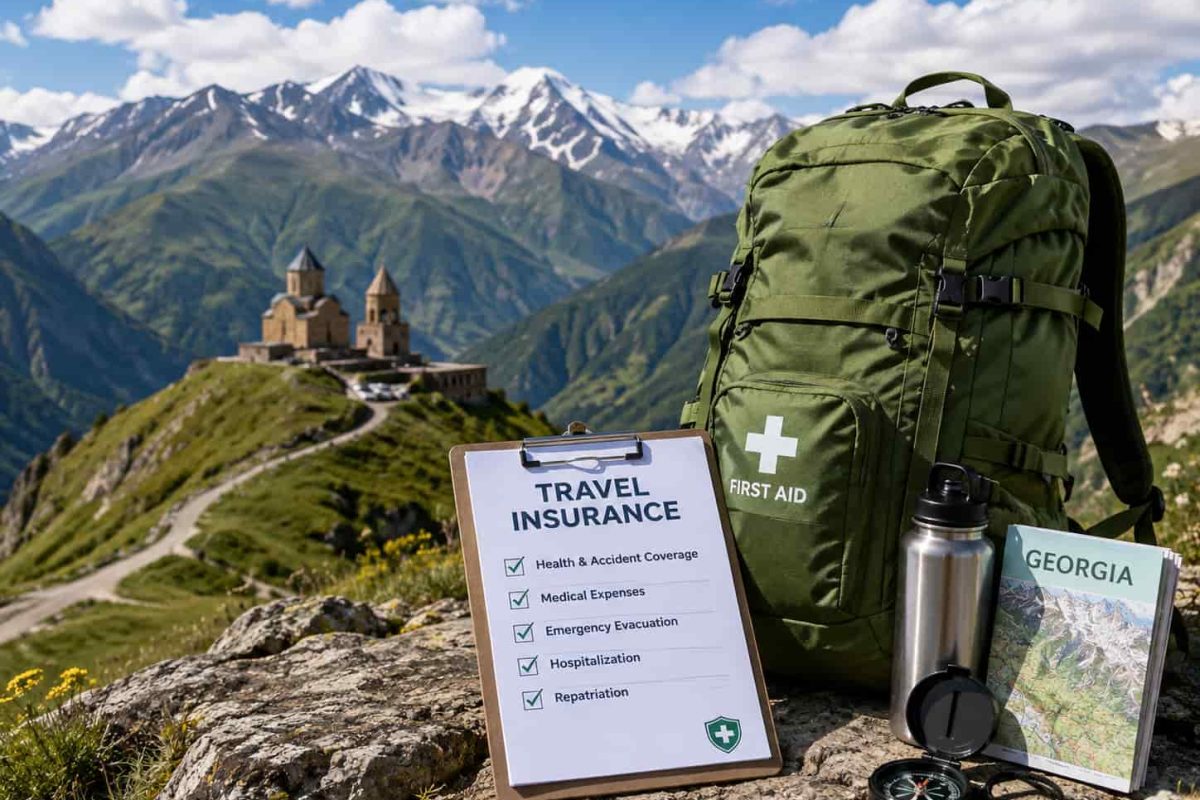
Finding a compliant insurance policy
Before purchasing, ask the insurer to confirm all of the following:
1. Is Georgia included in the geographical coverage?
2. Does the medical and accident limit meet or exceed 30,000 GEL?
3. Are both arrival and departure dates covered?
4. Can the insurer issue a certificate in English or Georgian?
5. Does the certificate show the required policy details?
6. Are your planned activities covered?
7. Is medical evacuation included?
8. Must you contact an assistance line before treatment?
9. Do you pay medical costs first and claim reimbursement later?
10. Are pre-existing conditions excluded?
The cheapest compliant policy may be adequate for a short urban visit. It may be unsuitable for skiing, multi-day trekking or remote mountain travel.
Option 1: Traditional travel insurance
A conventional single-trip policy is usually the most straightforward option for a holiday with fixed dates.
It commonly combines emergency medical and accident coverage with optional protection for:
- cancellation;
- interrupted travel;
- baggage;
- delays;
- personal liability;
- emergency evacuation;
- repatriation.
The advantage is that the insured period can match the trip precisely. The main risk is assuming that every travel insurance product automatically complies with Georgia’s rules.
Check the certificate, not only the marketing page. It should clearly show that Georgia is covered, the dates are correct and the medical or accident limit is high enough.
Annual multi-trip insurance can also work. However, confirm the maximum permitted duration of each individual journey. An annual policy may remain active for 12 months while limiting each trip to 30, 45, 60 or 90 days.
Option 2: Subscription-based travel insurance
Subscription-based policies charge monthly or annually and are often designed for frequent travellers, remote workers and people moving between countries.
They can satisfy the Georgian requirement when:
- the coverage is active before entry;
- Georgia is not excluded;
- the medical and accident limit is sufficient;
- the certificate covers the full stay;
- documentation is available in English or Georgian;
- the provider is a legally authorised insurer or issues coverage through one.
Pay particular attention to the meaning of “home country” and “country of residence.” Some international products limit protection in a country where the customer has established residence or spent a specified length of time.
Also check whether cancelling the subscription immediately ends coverage. A monthly payment model does not excuse a gap in insurance while the traveller remains in Georgia.
Option 3: Georgian insurance providers
The legislation allows visitors to purchase insurance from a Georgian provider. This can be useful when an existing foreign policy cannot generate a compliant certificate.
Georgia’s Insurance State Supervision Service lists licensed insurers operating in the country. As of 2026, the regulator states that 19 insurance companies hold life and non-life insurance licences.
Several Georgian companies have introduced products specifically for incoming visitors. For example, GPI Holding and Aldagi advertise dedicated mandatory tourist policies designed around the 2026 rules.
This does not mean one provider is automatically best. Compare:
- total medical coverage;
- exclusions;
- deductible or excess;
- reimbursement procedures;
- emergency assistance;
- sports coverage;
- age restrictions;
- refund terms;
- accepted payment cards.
A local policy may make the entry documentation easier, but it can still contain exclusions that matter after an accident.

Does credit card travel insurance qualify?
Credit card insurance can qualify. The law does not say that insurance must be purchased as a separate product.
The issue is proof.
A cardholder should obtain an official certificate from the insurer or assistance company showing:
- the insured traveller’s name;
- the destination or worldwide territory;
- the insured dates;
- health and accident protection;
- the coverage limit;
- the insurer’s details;
- the required contract information.
A bank card itself is not proof of the policy’s terms. Neither is a generic benefits booklet that does not identify the traveller or insured period.
Also verify any eligibility conditions. Some card-linked benefits apply only when flights or accommodation were paid for with the card.
Can you buy insurance at the airport or border?
Do not plan to buy it after reaching passport control.
The Georgian legislation does not guarantee that insurance sales will be available at every airport, railway terminal or land crossing. It also does not create an official right to enter temporarily in order to purchase a policy.
Some Georgian insurers sell visitor policies online and deliver the certificate by email. Buying before departure is safer than hoping a sales desk is open at the border.
Purchase the policy early enough to correct spelling, date or payment problems.
How to demonstrate proof of insurance
Keep the complete certificate, not only the payment receipt.
Before travelling, confirm that the document visibly shows:
- your full name as written in the passport;
- the policy number;
- the insurer’s name and contact details;
- Georgia or worldwide geographical coverage;
- health and accident risks;
- coverage of at least 30,000 GEL;
- the complete entry and departure period;
- the required insurance contract information;
- English or Georgian text.
Save the PDF:
- on your phone;
- in offline cloud storage;
- in your email;
- as a printed copy.
Travelling companions should each be identifiable on the policy. For a family policy, make sure every insured person appears in the certificate or attached schedule.
Air versus land entry points
The insurance rule is not limited to airports. The decree applies when a tourist enters Georgia, and an authorised representative of the Ministry of Internal Affairs may check the policy at a border checkpoint.
This includes entry by:
- international flight;
- road from Armenia or Turkey;
- an operating crossing from Russia;
- rail, when international passenger services are available;
- sea, where applicable.
Air travellers may encounter an additional check by the airline before boarding. Land travellers do not have that airline layer, but the same Georgian entry requirement applies at passport control.
Drivers entering in a foreign-registered vehicle should not confuse travel health insurance with compulsory vehicle liability insurance. Foreign vehicles are subject to a separate Georgian motor-insurance requirement.
Penalties, fines and enforcement
The clearest legal consequence is that an alien may be refused entry if they do not have health and accident insurance required under Georgian law.
The border regulation also expressly allows authorised officers to inspect the policy.
As of 3 August 2026, the official sources reviewed for this article do not state a clear fixed fine imposed specifically on an ordinary tourist solely for arriving without the new policy. The current consolidated Tourism Law lists a range of penalties for tourism businesses and providers of risky services, but no specific visitor fine for failure to hold the entry policy appears in its current Article 49.
For that reason, websites quoting a precise tourist fine without linking to a current legal provision should be treated cautiously.
The absence of a clearly stated fixed fine does not make insurance optional. Practical consequences can include airline problems, additional questioning and refusal of entry.
Staying long-term in Georgia
The insurance requirement applies throughout the tourist’s stay, with the insurance period defined for up to one year.
Travellers using Georgia’s long visa-free period should not buy a seven-day policy and assume it is enough because they were not checked after arrival. The obligation is to remain insured for the full period.
For a long stay:
- check the maximum trip length of the policy;
- confirm that renewal is possible while abroad;
- avoid any gap between two policies;
- determine whether travel insurance still covers you after establishing residence;
- consider local health insurance for routine medical care;
- keep emergency evacuation coverage where appropriate.
Georgia travel insurance and domestic health insurance serve different purposes. A low-cost visitor policy may focus on emergency treatment and accidents rather than routine appointments, preventive care or ongoing conditions.
Table of Contents





Final checklist
Before flying or crossing the land border, make sure your Georgia travel insurance policy meets the following requirements:
1. The policy covers health and accidents.
2. The limit is at least 30,000 GEL.
3. Georgia is included in the insured territory.
4. Arrival and departure dates are covered.
5. The certificate is in English or Georgian.
6. Your name matches your passport.
7. All required insurance details are visible.
8. The document is saved offline.
9. Every family or group member is named.
10. Planned sports and mountain activities are covered.
The practical answer to “Do you need travel insurance for Georgia?” is therefore unambiguous: yes. Border checks may appear inconsistent, but the legal obligation has applied since 1 January 2026. Buy the policy before travelling and judge it by the certificate and exclusions—not by the fact that another visitor was not asked to show theirs.



Comment (0)